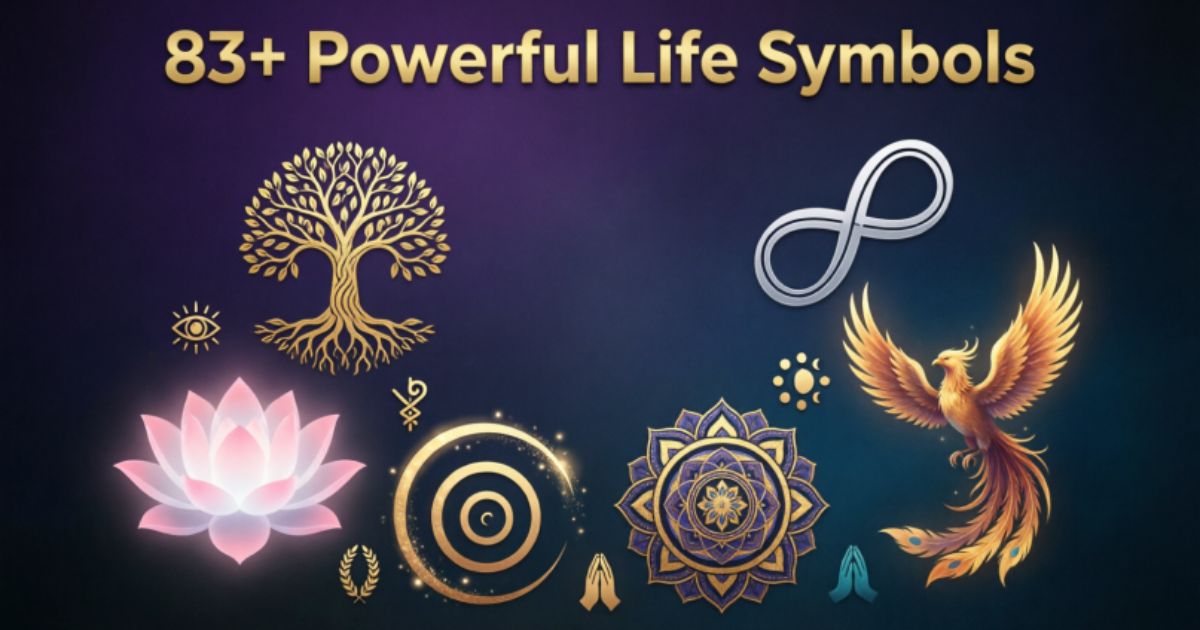

Every civilization that has ever existed on earth shared one common instinct: the need to give life a shape. Not just a definition written in a book, but a visual mark something you could carve into stone, wear around your neck, or paint on a wall that captured what it means to be alive. That instinct gave birth to life symbols.
From the tombs of ancient Egypt to the tattoo parlors of modern cities, life symbols have crossed every cultural, religious, and generational boundary imaginable. They speak where words fall short. They comfort where logic cannot reach. And they remind us, again and again, that life in all its fragility and beauty is worth honoring.
In this guide, you will explore 83+ powerful life symbols and their deep meanings, tracing their origins, their spiritual significance, and why they still matter today.
What Are Life Symbols?
Life symbols are visual signs, images, or objects that humans have used across history to represent the concept of existence, its beginning, continuation, renewal, and eternal nature. They are found in every culture on earth, from ancient Egyptian hieroglyphics to modern graphic design.
These symbols work because they make the abstract feel concrete. Eternity, soul, renewal these are ideas too large for a single sentence. But a symbol captures all of it in one glance. That is why symbols for life have appeared at every major human milestone: births, funerals, weddings, wars, and spiritual ceremonies.
People use life symbols in:
- Jewelry and accessories
- Tattoos and body art
- Architecture and home décor
- Religious rituals and ceremonies
- Art, literature, and film
Understanding what these symbols mean gives you access to thousands of years of accumulated human wisdom, encoded in simple, powerful images.
Life Symbols and Meanings
Before diving into specific categories, here is a broad overview of some of the most recognized life symbols and what they represent:
| Symbol | Origin | Core Meaning |
| Ankh | Ancient Egypt | Eternal life and immortality |
| Tree of Life | Multiple cultures | Growth, connection, continuity |
| Lotus Flower | Egypt, India | Purity, rebirth, spiritual awakening |
| Infinity Symbol | Mathematics / Spirituality | Endless existence, timeless love |
| Phoenix | Greece, China | Renewal, transformation, resurrection |
| Spiral | Universal | Evolution, personal growth, life cycles |
| Circle | Universal | Wholeness, the cycle of life |
| Scarab Beetle | Ancient Egypt | Regeneration, transformation |
| Ouroboros | Greece / Egypt | Eternal return, the cycle of all things |
| Celtic Knot | Celtic cultures | Interconnectedness, no beginning or end |
| Yin-Yang | China | Balance, duality, harmony |
| Om | Hinduism / Buddhism | The sound of the universe, divine creation |
Each of these symbols carries layers of cultural, spiritual, and personal meaning. Their power lies not just in what they represent, but in how long humans have agreed on that meaning.
Tree of Life Symbols
No symbol in human history has appeared across more unconnected cultures than the Tree of Life. It shows up in Norse mythology, in Celtic spirituality, in Judaism, in Egyptian cosmology, and in Native American traditions — independently, in each case, as a representation of the same idea: that life is rooted, growing, and reaching.
The Tree of Life visual language is consistent across cultures:
- The roots symbolize ancestors, history, and the earth
- The trunk represents strength, stability, and the present moment
- The branches reach toward sky and future growth and the unknown
What makes this symbol so enduring is that it shows everything at once: where you came from, where you stand, and where you are going.
Tree of Life Symbols and Meanings
The Tree of Life carries different names and slightly different meanings across traditions, but the core symbolism remains surprisingly consistent.
| Culture | Name | Specific Meaning |
| Norse | Yggdrasil | Connects nine worlds; axis of the universe |
| Celtic | Sacred Oak | Community, wisdom, eternal life |
| Judaism | Etz Chaim | Torah itself; divine wisdom |
| Egyptian | Ished Tree | Cosmic tree where the sun god rested |
| Hinduism | Ashvattha | Cosmos, spiritual enlightenment |
| Native American | World Tree | Connection between earth, man, and spirit |
| Christianity | Tree in Eden | Knowledge, life, and divine presence |
Today, the Tree of Life is one of the most popular symbols used in jewelry design, home décor, and tattoo art. Its popularity has never declined because its meaning touches something universal in human experience: the desire to feel connected — to the past, to the earth, and to something greater than ourselves.
Eternal Life Symbols
Across every culture and every era, humans have sought symbols that point beyond death toward something that continues. These are the symbols specifically associated with eternal life:
- The Ankh
The Egyptian cross with a loop, literally meaning “life” and “eternal existence”
- The Ouroboros
A serpent eating its own tail, representing the eternal return and the cycle that never ends
- The Infinity Symbol (∞)
Mathematical and spiritual, representing something that has no boundary and no end
- The Phoenix
The mythological bird that burns and rises, proving life has no final ending
- The Circle
A shape with no beginning and no end, representing the completeness of existence
- The Triquetra
A Celtic symbol of three interlocked arcs, representing the eternal flow of life, death, and rebirth
These symbols appear on gravestones, wedding rings, religious texts, and ancient temple walls alike. They are humanity’s answer to mortality — a visual declaration that existence is not finite.
Symbols of Life
Symbols of life span every artistic and spiritual tradition ever created. Here are some of the most significant:
Water
Nearly every culture treats water as a primary symbol of life. It nourishes, purifies, and sustains. In creation stories from Mesopotamia to the Bible, life emerges from water.
The Sun
The sun was worshipped as a life-giver in Egypt (Ra), in Aztec culture (Tonatiuh), and in countless other civilizations. Without the sun, nothing grows. It is perhaps the most universally recognized life symbol in existence.
Seeds and Grain
Agricultural civilizations created rich symbolism around seeds, wheat, and grain because they literally represented the continuation of life through cycles of planting, growth, harvest, and replanting.
The Heartbeat Line (EKG)
In modern culture, the electrocardiogram line has become a widespread symbol of life itself. You will find it on medical logos, memorial tattoos, and motivational designs worldwide.
The Double Helix (DNA)
Science gave us our most accurate modern symbol of life: the twisted ladder structure of deoxyribonucleic acid that carries the blueprint of every living thing on earth.
What Symbolizes Life
When people ask what symbolizes life, the answer depends on cultural context. But certain symbols appear so frequently across unconnected civilizations that they can be considered universal:
- The Ankh
the most direct historical symbol, literally meaning “life” in Egyptian hieroglyphics
- The Tree of Life
representing growth, connection, and continuity across dozens of cultures
- The Spiral
one of the oldest symbols humans ever carved, found in Neolithic art worldwide
- The Lotus
representing beauty and purity emerging from darkness and difficulty
- The Infinity symbol
representing life that does not end at the boundary of a single body or lifetime
Modern additions include the heartbeat line, the green leaf, and the DNA double helix — science’s contribution to the ancient human tradition of giving life a shape.
Symbol of Life
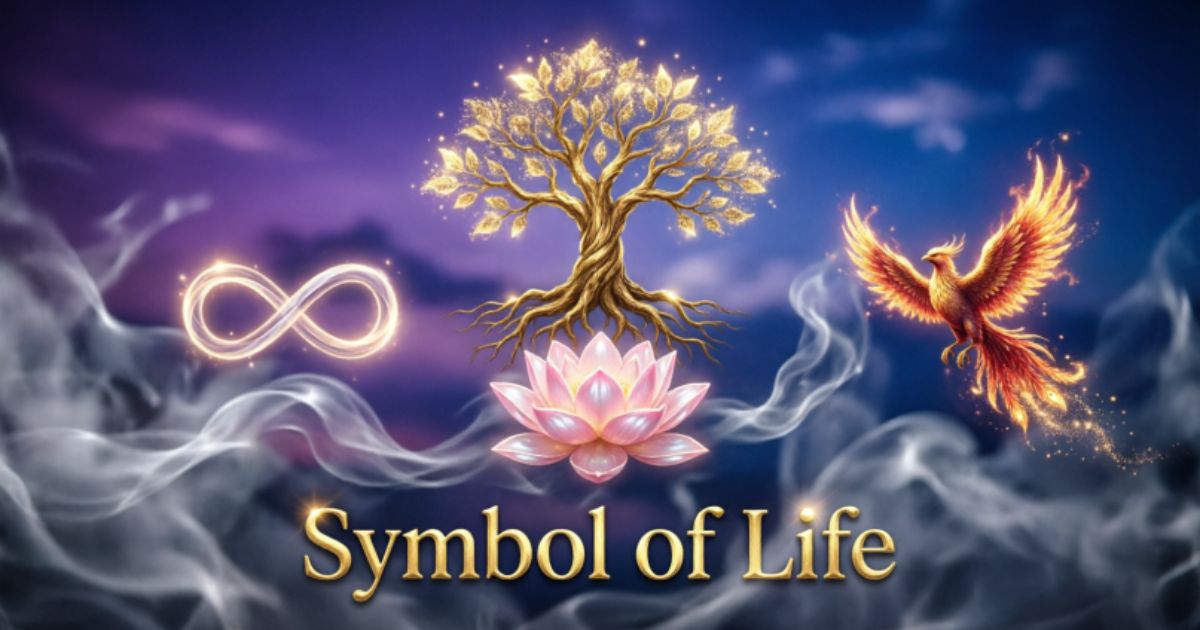
If one symbol had to be chosen as the definitive symbol of life, most historians and symbol scholars would point to the Ankh. No other symbol in recorded history carries such a direct, explicit connection to the concept of life. The word “ankh” in ancient Egyptian means life. The symbol itself was the hieroglyph used to write that word.
But symbolism is never one-size-fits-all. Across cultures, the following symbols have each served as the symbol of life in their tradition:
- Egypt
- Celtic tradition
- Buddhism and Hinduism
- Norse tradition
- Chinese philosophy
- Modern science
Life Symbols and Meanings
Here is a comprehensive table of 30 life symbols with their core meanings:
| # | Symbol | Meaning |
| 1 | Ankh | Eternal life, immortality |
| 2 | Tree of Life | Growth, ancestry, spiritual connection |
| 3 | Lotus Flower | Purity, rebirth, enlightenment |
| 4 | Phoenix | Transformation, renewal, resurrection |
| 5 | Infinity Symbol | Endless love, timeless existence |
| 6 | Spiral | Evolution, personal growth, life cycles |
| 7 | Circle | Wholeness, completeness, the cycle of life |
| 8 | Ouroboros | Eternal return, unity of all things |
| 9 | Scarab Beetle | Regeneration, protection, new beginnings |
| 10 | Eye of Horus | Protection, healing, restoration |
| 11 | Celtic Knot | Interconnectedness, eternity |
| 12 | Yin-Yang | Balance, harmony, duality |
| 13 | Om (Aum) | Divine creation, universal vibration |
| 14 | Triskele | Motion, the three realms of existence |
| 15 | Sun | Vitality, energy, life-giving power |
| 16 | Water | Purification, nourishment, new life |
| 17 | Green Leaf | Nature, growth, renewal |
| 18 | Butterfly | Transformation, change, new beginning |
| 19 | Rose | Love, life, beauty, fragility |
| 20 | Egg | Potential, birth, creation |
| 21 | Seed | Beginning, possibility, growth |
| 22 | Heartbeat Line | Life force, vitality, living presence |
| 23 | DNA Double Helix | Blueprint of life, biological existence |
| 24 | Rainbow | Hope, promise, new beginnings |
| 25 | Crescent Moon | Renewal, rebirth, cyclical existence |
| 26 | Mandala | Universe, wholeness, spiritual life |
| 27 | Dragonfly | Transformation, adaptability, living fully |
| 28 | Olive Branch | Peace, endurance, life and prosperity |
| 29 | Djed Pillar | Stability, rebirth, the backbone of life |
| 30 | Flower of Life | Sacred geometry, creation, universal structure |
Symbols for Life
Symbols for life appear in virtually every creative domain humans have worked in. Here are some you may recognize from everyday culture:
In medicine and health:
The caduceus and the Rod of Asclepius both use serpent animals long associated with renewal (because they shed their skin) as symbols of healing and the life force.
In religion:
The cross, the crescent and star, the Dharma wheel, the Star of David all of these carry meanings related to life, spiritual continuity, and divine existence.
In nature:
The egg, the seed, the blooming flower, the sunrise nature itself is a library of life symbols that humans drew from long before they created written language.
In modern culture:
The green heart, the sprouting seedling emoji, and the heartbeat graphic have all become recognized digital symbols for life and vitality.
Symbol for Change in Life
Transformation is one of the most important themes in symbolism. These symbols specifically represent change, transition, and new chapters:
- The Butterfly
The most universally recognized symbol of change. A caterpillar dissolving inside a chrysalis and emerging with wings is the perfect metaphor for personal transformation.
- The Phoenix
Rising from its own ashes, this mythological bird tells us that destruction is often the beginning of something greater.
- The Spiral
Unlike a circle, the spiral moves forward. It represents returning to the same themes in life, but at a deeper, evolved level each time.
- The Snake shedding its skin
Many cultures from Greece to Indigenous America have used the snake’s skin-shedding as a symbol of renewal and the willingness to release what no longer serves.
- The Chrysalis
The protective cocoon itself has become a symbol of being in transition — not yet arrived, but moving toward something new.
Symbols That Have Deep Meaning
Some symbols carry layers of meaning so dense that entire books have been written to unpack them. Here are the symbols considered most profound across multiple cultural traditions:
The Mandala
Originating in Hindu and Buddhist traditions, the mandala is a geometric representation of the universe. It symbolizes wholeness, eternity, and the self as a microcosm of the cosmos. The word “mandala” comes from Sanskrit, meaning “circle.”
The Caduceus
Two serpents winding around a staff topped with wings. Used by Hermes in Greek mythology, it represents balance, duality, and the communication between opposing forces.
The Triskele (Triple Spiral)
Found in ancient Irish stonework dating back over 5,000 years, the triskele is one of the oldest human symbols. Its three spirals represent motion, progress, and the three realms of existence: earth, sea, and sky.
The Flower of Life
A sacred geometry pattern made of overlapping circles forming a flower-like design. Found in ancient temples across Egypt, India, and China, it is believed to contain the geometric patterns underlying all of creation.
Things That Represent Life
Beyond abstract symbols, many concrete objects have become universally recognized representations of life:
- The heart
Both the biological organ and its stylized shape represent love, vitality, and the life force
- The candle flame
Fragile, warm, and temporary a perfect metaphor for human life
- The hourglass
Represents the passage of time and the finite nature of life
- The tree
In its physical form, a living tree represents growth, shelter, community, and endurance
- Fresh water
Springs, rivers, and rain are universal symbols of life’s sustenance
- The cradle or nest
A container of new life, representing beginnings and care
- Fire
Both destructive and generative, fire has been a symbol of life’s dual nature across thousands of years
What Represents Life
Life is represented differently across artistic, scientific, and spiritual traditions:
In art:
The color green (growth and vitality), golden light (divine life force), and upward movement (aspiration and growth) are all artistic conventions for representing life.
In science:
The DNA double helix, the heartbeat waveform, and the mitotic cell division diagram are modern scientific symbols of life.
In spirituality:
Light, breath, water, and sacred fire all represent the divine spark of life across multiple traditions.
In everyday language:
We describe a vibrant person as “full of life,” an exciting place as “lively,” and something meaningful as “life-giving.” Our language is saturated with life symbolism, even when we do not notice it.
Things That Symbolize Life
Here is a broader list of things physical, natural, and conceptual that have been used across cultures to symbolize life:
- Sunrise (new beginning, daily renewal)
- Spring season (rebirth after winter’s death)
- Rain (nourishment, fertility, cleansing)
- A bird in flight (freedom, the living spirit)
- A heartbeat sound (proof of living presence)
- A baby’s first cry (arrival of new life)
- A blossoming flower (beauty emerging from growth)
- The smell of rain on dry earth (petrichor associated with the earth “coming alive”)
- A green sprout pushing through concrete (life persisting against all odds)
- Moonrise (cyclical renewal, the rhythm of existence)
Symbol of Life Meaning
The meaning of life symbols goes far deeper than their visual appearance. Symbols of life serve several critical psychological and cultural functions:
Identity
When someone wears an ankh or a lotus tattoo, they are not just displaying art. They are declaring something about who they are and what they believe.
Memory
Life symbols appear on gravestones, memorial jewelry, and obituaries because they help people hold onto the idea that someone’s life had meaning and continues in some form.
Community
Shared symbols create shared identity. A group that rallies around a common symbol feels connected and purposeful.
Healing
Many people turn to life symbols during illness, grief, or difficulty because the symbol reminds them that life has cycles that what feels like an ending is often a transition.
Symbol for Life
When searching for the single best symbol for life, context matters enormously. Here is a quick guide:
| Purpose | Best Symbol |
| Tattoo representing new beginnings | Lotus Flower or Phoenix |
| Memorial jewelry for a lost loved one | Ankh or Tree of Life |
| Wedding or love gift | Infinity Symbol |
| Spiritual practice | Om, Mandala, or Flower of Life |
| Strength through difficulty | Phoenix or Spiral |
| Family connection | Tree of Life or Celtic Knot |
| Cultural heritage (Egyptian) | Ankh or Scarab |
| Modern minimal design | Heartbeat Line or DNA Helix |
Symbols That Represent Life
The following symbols are considered the most widely recognized representations of life across human civilization:
The Ankh
Direct, explicit, historically unambiguous. Used for over 4,000 years.
The Tree of Life
Appeared independently across Norse, Celtic, Egyptian, Jewish, Hindu, and Indigenous American traditions.
The Lotus
In both Hindu and Buddhist traditions, it represents the soul’s emergence toward enlightenment from the darkness of material existence.
The Spiral
Found in Neolithic cave paintings, Celtic stonework, and Japanese Zen art. One of humanity’s oldest and most consistent life symbols.
The Phoenix
Across Greece, China, Egypt, and the Middle East, the self-regenerating bird has served as a symbol of life’s indestructibility.
The Circle
The most fundamental geometric expression of wholeness and continuity.
What Symbol Represents Life
The most direct answer: the Ankh is the symbol most explicitly representing life in the historical record. The ancient Egyptian word for “life” was literally written with the ankh hieroglyph.
For modern audiences, however, the heartbeat (EKG) line has taken on this role in many contexts particularly in medical and memorial settings because it visually represents the living pulse.
The Tree of Life represents life in its most comprehensive, philosophical sense: as a connected, growing, rooted, and reaching thing.
Which symbol represents life best depends on what aspect of life you want to honor: biological existence, spiritual continuity, personal growth, or eternal connection.
Powerful Symbols with Deep Meanings
These symbols are considered among the most powerful ever created because they combine visual simplicity with philosophical depth:
| Symbol | Why It Is Powerful |
| Ankh | 4,000+ year history; directly means “life” |
| Ouroboros | Captures eternity in a single closed form |
| Mandala | Represents the entire universe in one pattern |
| Flower of Life | Found in multiple ancient civilizations independently |
| Om | Said to be the first sound of the universe |
| Eye of Horus | Combines protection, healing, and cosmic order |
| Triskele | Over 5,000 years old; still actively used |
| Infinity Symbol | Mathematical truth turned into emotional meaning |
Symbol That Represents Life
Among all life symbols ever created, the Tree of Life stands out as the most complete representation. Here is why:
It shows life as a process — not a single moment, but a continuous story with roots, stability, and growth. It includes the past (roots), the present (trunk), and the future (branches). It acknowledges that life is connected — to the earth, to ancestors, and to something that reaches beyond the visible.
It is also the most cross-cultural of all life symbols. Every major civilization independently arrived at the image of a sacred tree at the center of existence. That convergence is not coincidence it is evidence of something deep in human perception.
Symbols Representing Life
Here is an extended list of symbols representing life, organized by cultural origin:
Egyptian:
Ankh, Scarab, Djed Pillar, Eye of Horus, Lotus (Blue), Was Scepter
Celtic:
Celtic Knot, Triskele, Tree of Life (Crann Bethadh), Claddagh, Triquetra
Eastern:
Om, Lotus, Yin-Yang, Mandala, Dragon, Phoenix (Fenghuang)
Greek:
Olive Branch, Caduceus, Phoenix, Laurel Wreath, Meander Pattern
Norse:
Yggdrasil, Valknut, Vegvisir, Mjolnir (life through protection)
Native American:
Feather, Dreamcatcher, Medicine Wheel, Turtle (creation)
Modern / Universal:
DNA Helix, Heartbeat Line, Green Leaf, Infinity Symbol, Butterfly
Objects That Represent Life
Physical objects have served as life symbols throughout human history:
- Mirrors
In many cultures, mirrors were associated with the soul and with life itself
- Crystals
Particularly clear quartz, used in spiritual practice as a symbol of clarity and life energy
- Candles
Light as a metaphor for the living spirit
- Feathers
In Native American traditions, feathers represent the spirit, breath, and life
- Keys
The ankh is sometimes called the “Key of Life”; keys symbolize access to life’s mysteries
- Eggs
Universal symbol of potential and new life; used in spring festivals across cultures
- Stones engraved with spirals
Some of the oldest human-made objects, carved as symbols of the life cycle
Symbols Meaning Life
For quick reference, here are symbols specifically meaning life across traditions:
- Ankh (Egyptian)
The word and symbol for “life”
- Chi-Rho (Early Christian)
Monogram representing eternal life through Christ
- Aum/Om (Hindu/Buddhist)
The primordial sound from which life emerged
- Etz Chaim (Jewish)
Literally “Tree of Life” in Hebrew
- Dagaz (Norse Rune)
A rune representing new beginnings and the breakthrough of life
Symbolism for Life
Symbolism for life operates on multiple levels simultaneously:
Biological life
The egg, the seed, water, and sunlight symbolize life as a physical, natural process.
Emotional life
The heart, the flame, and the rose represent life as felt experience — love, passion, and connection.
Spiritual life
The lotus, the ankh, and the Tree of Life represent life as a sacred journey that extends beyond the physical.
Cyclical life
The spiral, the ouroboros, and the crescent moon represent life as a recurring pattern of seasons, ages, and reincarnation.
Understanding which level of life symbolism speaks to you helps you choose symbols that genuinely resonate with your personal beliefs and experiences.
What Symbolises Life
Life is symbolized by anything that captures these core qualities:
- Growth
Trees, spirals, sprouting seeds
- Continuity
Circles, infinity symbols, ouroboros
- Vitality
Fire, sun, heartbeat
- Renewal
Phoenix, butterfly, chrysalis, snake
- Connection
Celtic knots, Tree of Life, mandalas
- Purity
Lotus, water, white light
- Mystery
The eye, the moon, the labyrinth
Different symbols emphasize different aspects of life. The Ankh emphasizes existence itself. The Lotus emphasizes the spiritual journey. The Phoenix emphasizes transformation. Each is “correct” they just answer different questions about what life means.
Symbolism of Life
The symbolism of life is not static; it evolves as cultures change, merge, and develop. Some observations about how life symbolism functions:
Symbols absorb new meaning over time:
The Ankh began as a hieroglyph and became a spiritual icon, then a gothic subculture symbol, then a mainstream tattoo. Each layer of meaning adds depth without erasing what came before.
Death and life symbols are often the same:
The Phoenix destroys itself to be reborn. The skull (a death symbol) is also used to represent the precious fragility of life. The scarab was placed in the tombs of the dead to ensure their rebirth. Life and death are two faces of the same symbol in most traditions.
The most powerful life symbols are the simplest ones:
The circle. The spiral. The cross with a loop. These shapes are so simple they can be drawn by a child, yet they carry thousands of years of meaning.
Greek Life Symbols
Ancient Greece contributed some of the most enduring life symbols in human history. Greek life symbols usually represent wisdom, balance, strength, and harmony.
The Ankh-Style Cross (Sometimes Confused)
The Celtic and Armenian crosses are believed by some scholars to have been influenced by the Egyptian Ankh. While distinct symbols, their shared loop-over-cross structure suggests cross-cultural exchange of life symbolism across the ancient Mediterranean world.
The Greek Key (Meander)
The Greek Key pattern, a continuous angular spiral appears throughout Greek architecture, pottery, and textile design. It represents the eternal flow of life and the idea that existence moves in continuous, unbroken patterns. Found on temple friezes and home décor alike, the Meander is one of the most ancient decorative life symbols in Western tradition.
The Olive Branch
The olive branch is perhaps Greece’s most globally exported symbol. Associated with the goddess Athena who gave the olive tree to Athens as a gift it represents peace, endurance, and prosperity. Olive branches were used to crown Olympic champions, to open diplomatic negotiations, and to settle disputes. The phrase “extending an olive branch” still means offering peace today, thousands of years after the symbol first appeared in ancient Greece.
Other important Greek life symbols include:
- The Caduceus
Two serpents coiled around a staff, representing balance and the life force channeled through medicine and commerce
- The Laurel Wreath
Victory and the achievement of living fully
- The Phoenix
Appearing in Greek myth as a bird that cannot permanently die, it is perhaps Greece’s most powerful statement about the indestructibility of life
- The Rod of Asclepius
The true medical symbol, featuring one serpent and representing healing and the restoration of life
Flower of Life Symbols
The Flower of Life is a sacred geometric pattern made of 19 overlapping circles arranged in a hexagonal pattern. It has been found engraved and painted in ancient temples across Egypt, China, India, and Turkey civilizations that had little or no contact with each other.
This global appearance has led many spiritual traditions to view the Flower of Life as a fundamental pattern of creation, a visual map of how all life is structured at a foundational level. Metaphysically, it is said to contain the building blocks of all existence.
The Flower of Life contains within it other sacred patterns:
- The Fruit of Life
13 circles that form the basis for the Metatron’s Cube, said to contain every geometric shape found in the universe
- The Seed of Life
7 circles representing the seven days of creation in many traditions
- The Vesica Piscis
The intersection of two circles representing the union of opposites, widely used in early Christian symbolism
Today, the Flower of Life is used in meditation art, spiritual jewelry, and yoga spaces as a reminder of the interconnectedness of all living things.
Pro Life Symbols
Pro-life symbolism refers to visual symbols used to represent the value, sanctity, and protection of human life, particularly in the context of advocacy for unborn children. Common pro-life symbols include:
- The feet pin
A small gold pin shaped like fetal feet at 10 weeks of development, worn as a symbol of the recognition of life before birth
- The sunflower
Used in some pro-life movements to represent the value and growth of human life
- The open hands
Symbolizing protection, care, and welcome
- The white rose
Representing innocence and the purity of new life
These symbols vary by cultural and religious context, and their interpretation is deeply personal.
Greek Life Symbols and Meanings
| Greek Symbol | Meaning |
| Olive Branch | Peace, victory, life, and prosperity |
| Laurel Wreath | Achievement, honor, and the pursuit of excellence |
| Greek Key (Meander) | Eternity and the unbroken flow of life |
| Caduceus | Balance, healing, and the communication of life forces |
| Phoenix | Rebirth, renewal, and the impossibility of permanent death |
| Rod of Asclepius | Healing, medicine, and the restoration of life |
| Trident | Power over the seas water being the source of life |
| Owl of Athena | Wisdom as a guide through life |
The Ankh-Style Cross (Sometimes Confused)
While the Ankh is Egyptian, its influence reached across the ancient world. Early Coptic Christians (Egyptian Christians) transformed the Ankh into the Coptic cross. Some historians also believe the Celtic cross’s characteristic circle was inspired by the loop of the Ankh. This is one of history’s most compelling examples of life symbols traveling across cultural boundaries.
The Greek Key (Meander)
Named after the meandering Meander River in modern-day Turkey, the Greek Key is a repeating geometric pattern found on nearly every form of ancient Greek decorative art. Its endless, winding path with no break or termination point makes it a natural metaphor for the continuity of life and the passage of time.
The Olive Branch
The olive tree was so essential to Mediterranean life that its branch became the region’s most important life symbol. It provided food, oil, light (through oil lamps), medicine, and wood covering nearly every physical need of ancient life. When Athena gifted the olive tree to Athens, she was giving the city the gift of life itself.
Spiritual Life Symbols and Meanings
Spiritual life symbols point beyond physical existence toward something deeper: the soul, divine connection, and the continuation of consciousness beyond death.
Lotus Flower
The lotus is one of the most spiritually significant life symbols across multiple traditions. It grows in muddy, murky water conditions that would seem hostile to beauty yet blooms into a flower of extraordinary purity and elegance.
In Buddhism, the lotus represents the journey of the soul: growing through the mud of suffering and attachment, rising through the water of spiritual practice, and blooming in the light of enlightenment. In Hinduism, major deities including Brahma, Vishnu, and Lakshmi are depicted seated on lotus flowers. In ancient Egypt, the blue lotus was associated with creation and the daily rebirth of the sun.
Spiritually, the lotus teaches that beauty and wisdom emerge not despite difficulty, but because of it.
Tree of Life
Spiritually, the Tree of Life connects heaven and earth. Its roots reach into the underworld, its trunk stands in the human world, and its branches touch the divine realm. This vertical axis makes the Tree of Life a map of spiritual reality showing that humans exist at the intersection of the earthly and the divine.
In Kabbalah (Jewish mysticism), the Tree of Life is a diagram of the ten divine attributes through which God created and sustains the universe. In Norse mythology, Yggdrasil the World Tree holds nine realms of existence together. In both cases, the Tree is not just a symbol but the actual structure of reality.
Infinity Symbol
The infinity symbol carries spiritual meaning that goes well beyond mathematics. In spiritual practice, it represents the timeless nature of the soul, the idea that consciousness does not begin at birth and does not end at death. Many people wear the infinity symbol as a memorial to loved ones, as a declaration of permanent love, or as a reminder of their own spiritual nature. It represents eternal love, endless divine presence, and the idea that the soul lives outside the boundaries of time.
New Life Symbols
New life symbols specifically celebrate beginnings, births, and fresh starts:
- The sprouting seed or seedling
Possibility not yet realized, potential reaching upward
- The sunrise
A new day, a new chance; every morning is a small rebirth
- The egg
Life in its most protected, potential state, before it has yet broken through
- The spring crocus or snowdrop
Flowers that push through frozen ground, representing life’s insistence on beginning again
- The butterfly emerging from a chrysalis
The most visceral image of new life from what appeared to be stillness and ending
- The rainbow after a storm
Promise and hope following difficulty; a visual signal that the hard part is over and something bright is arriving
- The dove
Across traditions from the Hebrew Bible to modern peace movements, the dove represents the arrival of new hope and the possibility of peace
Base 12 Eternal Life Symbols
Base 12 (duodecimal) systems appear throughout ancient cosmology and are often connected to eternal life symbolism. The number 12 itself carries deep symbolic meaning across cultures:
- 12 months in a year the complete cycle of time
- 12 signs of the zodiac the complete cycle of cosmic influence
- 12 hours in a day and night the complete cycle of light
- 12 disciples in Christian tradition the complete circle of sacred community
- 12 tribes of Israel the complete nation of a people
In some esoteric traditions, 12 is considered the number of cosmic completeness, the point at which a cycle becomes whole and can begin again. Symbols associated with the number 12 are often used to represent the eternal, ever-renewing nature of existence. The clock face, the zodiac wheel, and the calendar circle all use 12 as their organizing principle, connecting timekeeping with eternity.
Egyptian Life Symbols
Egypt gave the world its most iconic collection of life symbols. Egyptian culture was deeply preoccupied with the relationship between life and death not as opposites, but as partners in an eternal cycle. Every major Egyptian symbol reflects this understanding.
The Ankh
The Ankh is the most explicit life symbol in all of human history. Shaped like a cross with a teardrop-shaped loop at the top, it was the hieroglyphic sign for the word “life” (ꜥnḫ). Egyptian gods were depicted holding the Ankh in paintings, reliefs, and sculptures across thousands of years the gesture signifying their power to give and sustain life. Pharaohs held the Ankh as a sign of divine authority. Commoners wore it as an amulet for protection and health.
The Ankh also represented the union between male and female (the cross being masculine, the loop feminine), and by extension the generative force from which all life springs. It was called the “Key of the Nile” because it was said to represent the union of Osiris and Isis the mythological flooding of the Nile that made Egyptian agricultural life possible.
The Scarab Beetle
The scarab beetle was sacred to the ancient Egyptians because of its behavior: dung beetles roll balls of dung across the ground, deposit eggs inside, and new beetles eventually emerge from the ball. The Egyptians saw in this a perfect image of the sun rolling across the sky, setting in the west (into death), and rising again in the east (into life).
The scarab became associated with Khepri, the god of the morning sun, and by extension with rebirth, regeneration, and transformation. Carved scarab amulets were placed over the hearts of the deceased during mummification, intended to protect and facilitate the soul’s rebirth into the afterlife.
The Djed Pillar
The Djed Pillar is one of Egypt’s oldest symbols, associated with Osiris the god of death and resurrection. It looks like a column with a series of horizontal bands near the top and is known as the “Backbone of Osiris.” The Djed represents stability, strength, and the endurance of life through difficulty.
“Raising the Djed” was an important Egyptian ceremony performed during festivals of Osiris, in which a Djed pillar was ceremonially erected as an act of affirming life’s continuation over death’s apparent finality. It is essentially a symbol of life’s resilience its ability to remain upright and strong even in the face of adversity.
The Eye of Horus
The Eye of Horus (Wedjat) is a symbol of healing, protection, and the restoration of life. According to Egyptian myth, the god Horus lost his eye in a battle with Set the god of chaos and destruction and the eye was later healed and restored. This act of restoration made the Eye of Horus a symbol of the healing power of life itself: the ability to recover from damage and return to wholeness.
The Eye of Horus was one of the most widely used protective amulets in ancient Egypt. It was placed in tombs, worn as jewelry, and painted on boats to protect them. It also served as a symbol of life returning after illness, injury, or loss.
Life Symbols With Meaning
Every life symbol carries at least three layers of meaning:
- Historical meaning
What the symbol originally represented in its culture of origin
- Universal meaning
What the symbol communicates across cultural boundaries, based on its visual form
- Personal meaning
What the symbol means to the individual who chooses to wear or display it
The most resonant life symbols work on all three levels simultaneously. When someone gets a phoenix tattoo after recovering from addiction, they are drawing on Greek mythology, the universal understanding of fire as both destructive and regenerative, and their own personal story of burning away the old self to become someone new.
Life Symbols Casket Corners
Throughout history, life symbols have appeared on caskets and burial objects as declarations that death is not the final word. Common life symbols used in funeral contexts include:
- The Ankh
Placed in Egyptian tombs to ensure rebirth
- The Tree of Life
Carved on casket panels to represent the continuation of existence
- The Phoenix
As a statement of resurrection and eternal continuation
- The Infinity Symbol
To honor a life that continues beyond the physical
- Floral motifs (Lotus, Rose)
Representing beauty and the blossoming of the soul
- The Hourglass with wings
A symbol of time taking flight the soul freed from temporal limitation
In Victorian memorial culture especially, caskets were richly decorated with symbolic imagery, and each symbol carried a specific message about the deceased’s life, faith, and expected afterlife.
Everyday Life Symbols
Life symbols are all around us, even in contexts we would not normally call symbolic:
- Traffic lights
The green light (go, proceed, live) has absorbed life-affirming meaning culturally
- The smiley face
A modern life symbol representing vitality, joy, and the celebration of living
- The heart emoji
Instantly recognized worldwide as a symbol of love and life
- The green cross
Used internationally for pharmacies and first aid, representing the preservation of life
- The dove on wedding invitations
Peace, new beginnings, and the life being built together
- Candles on a birthday cake
An ancient ritual: the number of flames representing years of life, blown out as a wish for more
Life symbolism is embedded so deeply in everyday culture that most people engage with it multiple times daily without realizing it.
Real Life Symbols of Rebellion
Some of the most powerful symbols in modern history began as life symbols repurposed in protest:
- The raised fist
Originating as a symbol of solidarity and the fight for the right to live freely
- The peace sign
Designed in 1958 for the British nuclear disarmament movement, it represents the demand for the preservation of all life
- The pink triangle
xOriginally used to mark LGBTQ+ prisoners in Nazi concentration camps, it was reclaimed in the 1970s as a symbol of life, pride, and resistance
- The red ribbon
Adopted in 1991 as a symbol of awareness and compassion for those living with HIV/AIDS
- The sunflower
Used in multiple social movements as a symbol of life, hope, and the right of all living things to grow toward the light
These symbols carry both life meaning and resistance meaning simultaneously — they say both “life is precious” and “we will fight to protect it.”
Deep Symbolic Meaning of Life Symbols
The deepest meaning of life symbols is not decorative, it is existential. Life symbols exist because humans are the only species that knows it will die, and must find a way to live meaningfully anyway.
A symbol does not remove the reality of death or suffering. What it does is place that reality within a larger story, one where death is a transition rather than an endpoint, where suffering has purpose, where growth is possible even from the darkest conditions (like the lotus in the mud).
That is the true power of life symbols. They do not deny difficulty. They reframe it. And that reframing has given strength to human beings across every century and every culture that has ever existed.
Types and Variations of Life Symbols
1. The Tree of Life
The Tree of Life appears in an extraordinary range of visual styles: the interlaced Celtic version, the angular Norse Yggdrasil, the flowing Jewish Kabbalistic diagram, and the naturalistic versions found in jewelry and tattoo design. Each variation emphasizes different aspects rootedness, connection, growth but all share the central meaning of life as something that reaches simultaneously into earth and sky.
2. The Ankh
The Ankh has appeared in its original form for over 4,000 years and remains visually almost unchanged. Modern variations include jeweled versions, minimalist outline designs, and stylized interpretations used in Gothic and alternative cultural contexts. Its loop-over-cross form is so instantly recognizable that even subtle variations retain their meaning.
3. The Infinity Symbol
Originally a mathematical sign (∞), the infinity symbol has been adopted in spiritual, romantic, and memorial contexts. Variations include the infinity symbol with a heart at the center, versions with names or dates inscribed, and the figure-eight ouroboros that replaces the geometric sign with a serpent eating its own tail.
4. The Spiral
The spiral appears in an enormous variety of forms: the single Archimedes spiral, the double nautilus spiral, the Celtic triple spiral (Triskele), the Fibonacci spiral (found in seashells, galaxies, and plant growth), and the decorative spiral in Maori tribal art. Each carries the core meaning of life as movement, growth, and the cyclical return to deeper levels of understanding.
5. The Lotus Flower
The lotus appears differently in Egyptian and Asian traditions. The Egyptian Blue Lotus has more pointed petals and is associated with creation and the sunrise. The Asian lotus — most commonly the Pink or White Lotus — is the symbol of Buddhist enlightenment. Modern versions in tattoo and jewelry design tend toward the simplified, symmetrical form familiar from yogic and wellness contexts.
6. The Phoenix
The Phoenix appears in dramatically different visual traditions. The Greek Phoenix is a large, golden-red eagle-like bird. The Chinese Fenghuang is a more ornate, multi-colored creature associated with feminine energy and harmony. Modern interpretations range from realistic to highly stylized flame-birds. All versions share the core meaning: fire as both destroyer and creator.
7. The Circle
The circle is perhaps the simplest life symbol and the most universal. As the Ouroboros, it becomes a serpent. As the mandala, it becomes a map of the cosmos. As the Celtic Knot, it becomes an expression of eternity. As the wedding ring, it becomes a declaration of permanent love. The circle is the root form from which dozens of life symbols grow.
Life Symbols Across Cultures
Ancient Egypt
Egypt’s life symbolism was built around one central belief: that death was not an ending but a transition. The Ankh, Scarab, Lotus, and Eye of Horus all reflect this worldview — each in its way representing the soul’s journey from physical death to spiritual rebirth. Egyptian life symbols are among the most visually consistent in history, having remained recognizable for over 4,000 years.
Celtic Culture
The Celts expressed life through art forms characterized by endless interlocking: knots with no beginning and no end, spirals that flow into each other, and trees whose roots and branches are equally elaborate. Celtic life symbolism emphasizes interconnectedness — the idea that life is a web of relationships, not a solitary journey.
Eastern Cultures
In Hinduism and Buddhism, life symbols tend to emphasize the soul’s journey rather than physical existence. The Lotus represents awakening. The Om represents the vibration from which existence emerged. The Mandala represents the cosmos as a living, ordered whole. Eastern life symbolism is often more inward-looking ,concerned with inner life, spiritual growth, and the nature of consciousness.
Greek Mythology
Greek life symbolism is rich with narrative each symbol comes embedded in a story. The Phoenix has a myth. The Olive Branch has the story of Athena and Poseidon. The Caduceus belongs to Hermes. This storytelling tradition made Greek symbols extraordinarily durable, they carried their meaning in a story that could be retold, making them memorable and teachable across generations.
Native American Culture
Native American life symbolism is deeply connected to the natural world. The eagle (spirit and vision), the turtle (creation and longevity), the bear (strength and healing), and the feather (breath and spiritual connection) are all life symbols rooted in observation of the natural world. The Medicine Wheel,a circle divided into four quadrants representing the four directions, seasons, and stages of life is one of the most sophisticated life symbols in any tradition.
Life Symbols in Art, Movies and Pop Culture
Life symbols have never been more visible than in contemporary popular culture:
In film:
The Tree of Life appeared as the central metaphor in Terrence Malick’s 2011 film of the same name. The Ankh is a recurring symbol in films dealing with Egyptian mythology. The Phoenix appears in the Harry Potter series as Fawkes Dumbledore’s companion and symbol of hope and renewal.
In music:
Artists from Beyoncé to Led Zeppelin have embedded life symbols in album artwork, music videos, and stage design. The butterfly has been used by artists including Mariah Carey and Nick Minaj as a personal life symbol.
In tattoo art
: The lotus, phoenix, tree of life, and infinity symbol are consistently among the most requested tattoo designs worldwide not for aesthetic reasons alone, but because people want to carry their life symbols on their skin.
In fashion:
The Ankh enjoyed a major revival in the 1990s hip-hop scene and has never fully left mainstream fashion. Life symbols appear on high fashion runways, streetwear brands, and fast fashion collections with remarkable regularity.
Spiritual and Dream Meaning of Life Symbols
In dreams, life symbols often carry amplified meaning because the dreaming mind communicates in images rather than words.
Dreaming of a Tree of Life often signals a period of personal growth, a reconnection with family or roots, or a desire for stability and grounding.
Dreaming of a Lotus may indicate that the dreamer is in the process of rising above a difficult situation that spiritual or emotional enlightenment is near.
Dreaming of a Phoenix often follows a period of significant loss or transformation the dreaming mind’s way of saying: “you are not destroyed. You are becoming.”
Dreaming of an Infinity Symbol may represent a desire for permanence a relationship, a value, or a sense of self that the dreamer wants to believe will never end.
Dreaming of the Ankh is sometimes interpreted as a message from the subconscious about life purpose a reminder to ask what kind of life one is actually living.
Positive and Negative Meaning of Life Symbols
Like all symbols, life symbols carry both positive and negative dimensions of meaning depending on context.
Positive Meaning
- Growth, renewal, and transformation (Phoenix, Butterfly, Lotus)
- Eternal love and connection (Infinity Symbol, Celtic Knot)
- Divine protection and blessing (Eye of Horus, Ankh)
- Strength through difficulty (Tree of Life, Djed Pillar)
- The soul’s continuation beyond physical death (Ankh, Phoenix, Ouroboros)
Negative Meaning
- The Ouroboros can represent stagnation being trapped in an endless loop without progress
- The Spiral can represent obsession or getting lost in one’s own thoughts when taken to an extreme
- The Phoenix requires destruction before rebirth it can symbolize the painful endings that precede new beginnings
- The Skull (used alongside life symbols) reminds us of mortality’s absolute nature life symbols seen next to a skull can carry a memento mori (remember you will die) meaning
- The Hourglass represents the finite, running-out nature of time a warning as much as a comfort
Why Humans Are Attracted to Life Symbols
The attraction to life symbols is not superficial. It is rooted in how the human brain works.
Humans are pattern-seeking creatures. The brain naturally attaches meaning to visual shapes, particularly when those shapes have been associated with powerful emotions across centuries. When you see the Tree of Life, your mind connects it instantly to roots, strength, family, and growth not because you were taught a textbook definition, but because the symbol has been layered with that meaning for millennia, and that layer transfers to you through cultural exposure.
Life symbols also serve deeply personal functions. People who have survived illness, loss, or transformation often turn to life symbols to mark the experience. A phoenix tattoo after a difficult year. An ankh worn during grief. A lotus on the wrist of someone who has risen from a painful chapter. These are not decorations. They are declarations.
In a world that changes rapidly and constantly, life symbols offer something rare: permanence. The Ankh meant the same thing 4,000 years ago that it means today. The lotus has bloomed from the same muddy conditions in Buddhist iconography for over 2,500 years. That continuity is deeply comforting to humans who feel the instability of their own moment.
Finally, life symbols give people a way to communicate identity and belief without words. A single symbol on a piece of jewelry or skin can say: “I believe in transformation.” “I honor my ancestors.” “I have survived something and I am still here.” That economy of expression, everything in one image is one of the most powerful things a human being can wear.
Conclusion
Life symbols are not relics of ancient superstition. They are one of humanity’s most sophisticated tools for navigating existence, giving shape to ideas too large for words, providing comfort in the face of mortality, and connecting individuals to something larger than themselves.
Whether you are drawn to the ancient power of the Egyptian Ankh, the cross-cultural wisdom of the Tree of Life, the spiritual depth of the Lotus, or the transformative energy of the Phoenix, you are participating in one of the oldest human traditions: the search for symbols that help make sense of being alive.
The symbols change in style but not in substance. They always circle back to the same truth: that life is precious, interconnected, cyclical, and worth honoring. Whatever symbol speaks to you wear it, draw it, meditate on it. Let it remind you, as it has reminded human beings for thousands of years, that your life has meaning.