
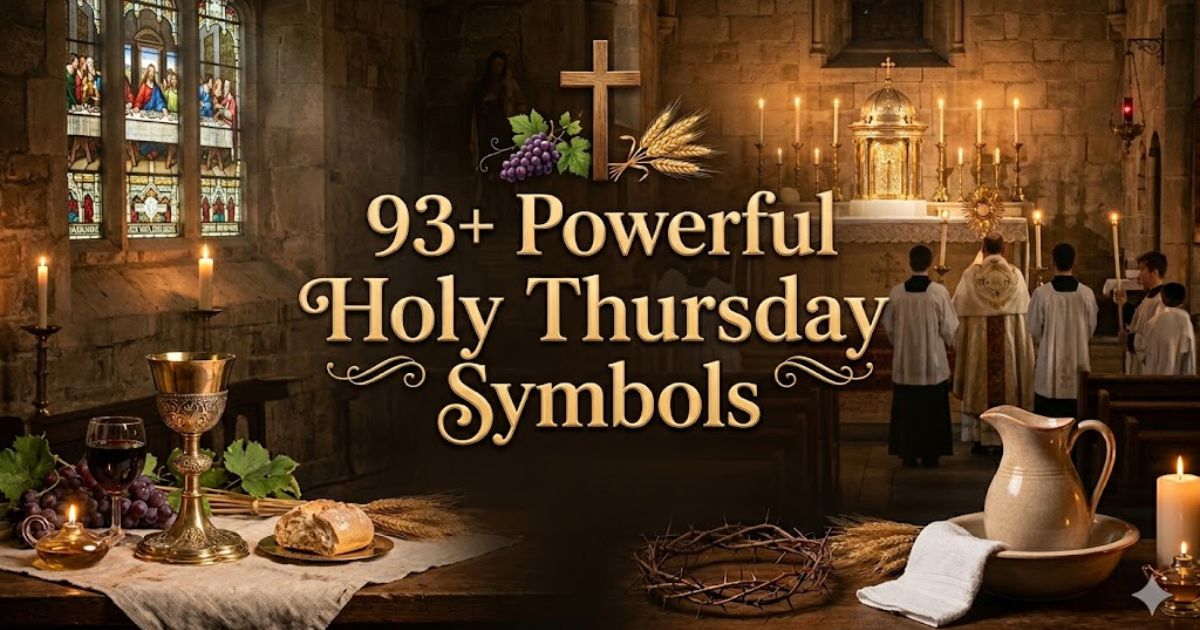

Holy Thursday is one of the most symbol rich days on the Christian calendar. Every gesture, object, and ritual performed on this day carries layers of meaning that stretch back thousands of years.
From the bread and wine shared at the Last Supper to the quiet act of washing feet, Holy Thursday symbols help believers connect with a story of humility, sacrifice, and love. Whether you are preparing for Holy Week, researching for a school project, or simply curious about what these symbols represent, this guide breaks down everything in one place.
We will walk through more than 93 symbols, their meanings, how they appear across cultures, and why they continue to resonate with people today.
What Are Holy Thursday Symbols?
Holy Thursday symbols are the objects, actions, colors, and images associated with the events of the Last Supper and the night before Jesus Christ’s crucifixion. They include physical items like bread, wine, and a basin of water, as well as actions like foot washing and the stripping of the altar.
These symbols are not random. Each one points back to a specific moment in the Gospel accounts, particularly the Last Supper described in Matthew, Mark, Luke, and John. Together, they form a visual and spiritual language that churches use to retell the story of that final night.
Understanding these symbols helps deepen the experience of Holy Week, whether you are attending Mass, leading a Sunday school lesson, or reflecting privately at home.
Holy Thursday Meaning And Symbolism
Holy Thursday Meaning
Holy Thursday marks the day Jesus shared his final meal with his disciples before his arrest and crucifixion. It is also called Maundy Thursday, a name that comes from the Latin word mandatum, meaning commandment, referring to Jesus’s instruction to love one another.
This day commemorates several major events at once. These include the institution of the Eucharist, the washing of the disciples’ feet, and the beginning of the Easter Triduum, which leads into Good Friday and Easter Sunday.
Thursday Symbolism
Beyond its religious context, Thursday itself carries symbolic weight in many traditions as a day of transition and preparation. In the Christian calendar, Holy Thursday acts as a bridge between the reflective season of Lent and the sorrowful events of Good Friday.
The symbolism of this particular Thursday is tied closely to themes of service, sacrifice, and new beginnings, setting the tone for the rest of Holy Week.
Happy Holy Thursday
Some people use the greeting “Happy Holy Thursday” as a way to acknowledge the day with warmth, similar to other religious greetings. However, many Christians prefer more reflective language, since Holy Thursday carries a solemn tone that leads into the sorrow of Good Friday.
A more common alternative is wishing someone a “blessed Holy Thursday,” which respects the spiritual weight of the day while still offering a kind sentiment.
Holy Week Symbols And Meanings
Holy Week Symbols And Meanings
Holy Week is filled with symbols that build on each other day by day. Palm Sunday begins with palm branches representing triumph and humility. By midweek, the mood shifts toward reflection, and Holy Thursday introduces symbols of service and sacrifice.
Each symbol throughout Holy Week connects to a specific moment in the final days of Jesus’s life, creating a continuous visual story that culminates in the resurrection on Easter Sunday.
Good Friday Symbol
The most recognized Good Friday symbol is the cross, representing the crucifixion of Jesus. Other common symbols include the crown of thorns, nails, and the color red or black, which reflect suffering and solemnity.
These symbols stand in contrast to the symbols of Holy Thursday, which focus more on community, service, and the institution of the sacraments, before shifting into the heavier symbolism of the following day.
Holy Thursday Symbols Catholic
Holy Thursday Symbols Catholic
In Catholic tradition, Holy Thursday is marked by specific liturgical symbols that appear during the Mass of the Lord’s Supper. These include the washing of feet, the procession of the Blessed Sacrament, and the stripping of the altar at the end of the service.
Each of these elements is rooted in centuries of Catholic liturgical practice and is performed with intention and reverence.
Catholic Holy Thursday Symbols
Some of the most important Catholic Holy Thursday symbols include:
- The Chrism Mass, where holy oils are blessed for use throughout the year
- The washing of feet, recalling Jesus washing his disciples’ feet
- The Eucharistic procession after Mass
- The stripping of the altar, symbolizing abandonment
- The Tabernacle being left open and empty
These symbols are often experienced together in a single evening liturgy, creating a powerful sensory and spiritual experience for those attending.
Maundy Thursday Symbols Explained
Maundy Thursday Symbols
Maundy Thursday and Holy Thursday refer to the same day, so their symbols overlap completely. The word Maundy points specifically to the commandment Jesus gave his disciples to love one another as he had loved them.
This focus on commandment and service is why foot washing holds such a central place among Maundy Thursday symbols.
Symbols Of Maundy Thursday
The core symbols of Maundy Thursday include the basin and towel used for foot washing, the bread and wine of the Eucharist, and the gesture of kneeling, which represents humility and service rather than authority.
Maundy Thursday Symbol
If you had to choose a single defining Maundy Thursday symbol, most theologians would point to the basin and towel. This simple combination captures the essence of the entire day, a leader choosing to serve rather than be served.
Maundy Thursday Holy Thursday Symbols
Because Maundy Thursday and Holy Thursday are the same observance, their symbols are interchangeable. Whether referred to by one name or the other, the imagery of bread, wine, water, towels, and an emptied altar remains consistent across denominations.
Symbols Of Holy Thursday
Symbols Of Holy Thursday
When people search for symbols of Holy Thursday, they are usually looking for a complete list of the imagery tied to this day. Below is a categorized breakdown.
| Category | Symbols |
| Eucharistic | Bread, wine, chalice, paten, unleavened bread |
| Service | Basin, towel, water, washing of feet |
| Liturgical | Stripped altar, empty tabernacle, white vestments |
| Biblical figures | The twelve apostles, Judas, Peter |
| Garden related | Olive branches, Gethsemane garden, night vigil |
| Light and darkness | Candles, dimmed lights, silence after Mass |
Symbols For Holy Thursday
Symbols for Holy Thursday are often chosen to represent themes of community and sacrifice. Common choices for decorations, bulletins, or lessons include images of the Last Supper table, a simple loaf of bread, a cup of wine, and a basin with a towel draped over the edge.
Holy Thursday Symbol
A single Holy Thursday symbol that stands out across nearly every tradition is the chalice, representing the cup Jesus shared with his disciples and identified as his blood.
Symbol For Holy Thursday
When choosing one symbol for Holy Thursday for educational or artistic purposes, the combination of bread and wine together is often preferred, since it captures both the meal itself and its sacramental meaning.
Symbol Of Holy Thursday
The symbol of Holy Thursday that appears most often in religious art is the Last Supper table itself, with Jesus seated among his twelve disciples, often depicted at the moment of institution of the Eucharist.
Last Supper And Eucharist Symbols
Last Supper Holy Thursday Symbols
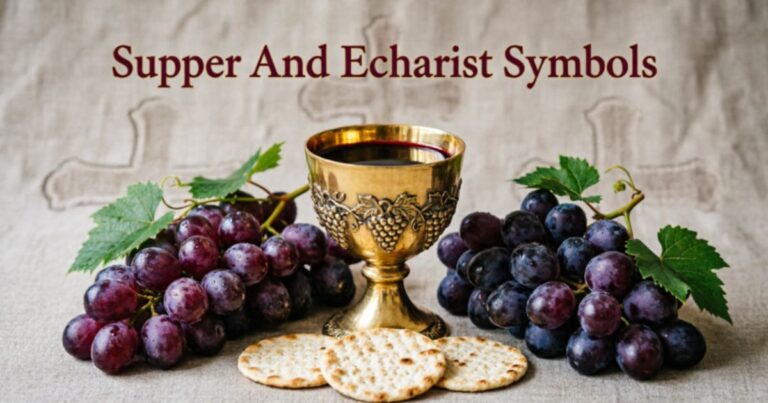
The Last Supper introduces several symbols that remain central to Christian worship. These include the bread, broken and shared as a symbol of Jesus’s body, and the wine, poured out as a symbol of his blood.
Supper Holy Thursday Symbols
Beyond bread and wine, the supper itself carries symbolic weight. The act of reclining together at a shared table represents fellowship, equality, and the intimacy between Jesus and his closest followers.
Holy Eucharist Holy Thursday Symbols
The Holy Eucharist is the sacrament instituted at the Last Supper, and its symbols include the host, the chalice, the altar, and the priestly vestments worn during its celebration. These elements are central to Catholic and many Protestant observances of Holy Thursday.
Washing Of Feet Symbols
Feet Holy Thursday Symbols
The feet themselves become symbolic on Holy Thursday, representing the lowest and often most overlooked part of the body. By washing feet, Jesus elevated an act of humility into a model for how his followers should treat one another.
Washing Holy Thursday Symbols
The act of washing is symbolic of cleansing, renewal, and service. It mirrors the spiritual cleansing offered through the sacraments while also serving as a literal demonstration of care for others.
Washing Feet Holy Thursday Symbols
Washing feet on Holy Thursday is often reenacted in churches, where clergy or community leaders wash the feet of selected members of the congregation, echoing the original event described in John’s Gospel.
Jesus Washing Feet Holy Thursday Symbols
The image of Jesus washing feet is one of the most powerful in Christian art. It shows a teacher and leader performing a task typically reserved for servants, reinforcing the message that true greatness is found in serving others.
Creative And Visual Symbols
Clipart Holy Thursday Symbols
For educational materials, bulletins, or social media, simple clipart style Holy Thursday symbols are popular. These often include illustrations of a chalice, bread loaf, basin and towel, candles, or a simplified Last Supper table.
Action Holy Thursday Symbols
Beyond static images, Holy Thursday is also represented through actions, sometimes called living symbols. These include the act of kneeling, the physical washing of feet, the procession of the Eucharist, and the silence observed after the evening liturgy ends.
Holy Thursday Images And Downloads
Holy Thursday Images Free Download
Many churches and religious organizations offer free downloadable images for Holy Thursday, typically featuring the Last Supper, a chalice and host, or a basin and towel. These are commonly used in bulletins, presentations, and social media posts during Holy Week.
Maundy Thursday Images 2026
For 2026, popular image themes continue to focus on foot washing scenes, communion elements, and simple line art versions of traditional symbols, making them easy to use across digital and print formats.
Deep Symbolic Meaning
At its core, Holy Thursday is about reversal. The one who could have demanded service instead offered it. The meal that should have been ordinary became sacred. The night that ended in betrayal began with an act of profound love.
This reversal is what gives Holy Thursday symbols their lasting power. They are not just historical markers, they are invitations to reconsider what leadership, love, and sacrifice actually look like.
Types / Variations of Holy Thursday Symbols
The Bread and Wine
Bread and wine represent the body and blood of Christ, forming the foundation of the Eucharist. Unleavened bread connects directly to the Passover meal, while wine represents the new covenant established through Jesus’s sacrifice.
The Basin and Towel
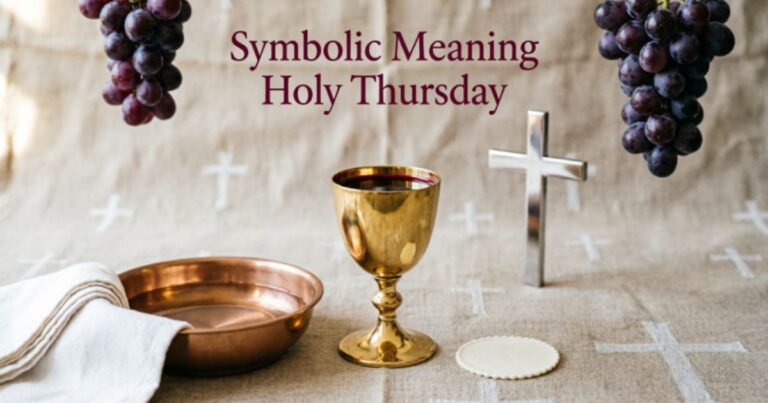
The basin and towel symbolize humility and service. They are physical reminders of the moment Jesus knelt before his disciples, performing a task usually left to the lowest servant in a household.
The Chalice
The chalice represents the cup shared at the Last Supper. In many depictions, it is shown glowing or elevated, emphasizing its sacred role in the institution of the Eucharist.
The Twelve Disciples
The twelve disciples represent the foundation of the early church and, by extension, all believers. Their presence at the table highlights themes of community, imperfection, and forgiveness, especially given that one of them would soon betray Jesus.
The Stripped Altar
After the Holy Thursday liturgy, the altar is stripped bare. This visually represents abandonment and foreshadows the suffering Jesus would face the following day. The empty altar remains until the Easter Vigil, creating a stark visual transition through Good Friday.
Holy Thursday Symbols Across Cultures
While the core symbols of Holy Thursday remain consistent across Christian denominations, cultural traditions add unique layers. In some Latin American countries, elaborate processions and home altars incorporate local flowers and foods alongside traditional symbols.
In parts of Europe, Holy Thursday is associated with specific foods, such as twelve different dishes representing the twelve apostles. In Eastern Orthodox traditions, the washing of feet is often performed by bishops in elaborate public ceremonies, adding a regional flavor to a universally recognized symbol.
These cultural variations show how a shared symbolic foundation can be expressed in diverse and meaningful ways around the world.
Holy Thursday Symbols in Art, Movies and Pop Culture
Holy Thursday symbols have inspired countless works of art throughout history. The Last Supper has been painted, sculpted, and depicted in stained glass by artists across centuries, with each version emphasizing different emotional or theological details.
In film and television, scenes referencing the Last Supper often use the same visual cues, a long table, bread and wine, and a central figure surrounded by companions, to evoke themes of betrayal, sacrifice, or final farewells, even outside explicitly religious contexts.
This crossover into mainstream culture shows how deeply these symbols have embedded themselves into shared visual storytelling.
Spiritual and Dream Meaning of Holy Thursday Symbols
For many believers, Holy Thursday symbols carry meaning beyond the liturgical calendar. Dreaming of a shared meal, a basin of water, or a quiet garden during Holy Week is sometimes interpreted as a reflection of personal humility, forgiveness, or a need for spiritual renewal.
While not formally documented in religious teaching, these personal interpretations often draw on the same themes the symbols represent in scripture, service, sacrifice, and transformation.
Positive vs Negative Meaning
| Symbol | Positive Meaning | Negative or Sorrowful Meaning |
| Bread and Wine | Unity, nourishment, covenant | Reminder of sacrifice and suffering |
| Basin and Towel | Humility, service, love | Discomfort with vulnerability |
| Chalice | Sacred covenant, communion | Symbol of the suffering to come |
| Stripped Altar | Preparation for renewal | Abandonment, loss |
| Twelve Disciples | Community, faith | Betrayal, human weakness |
Why Humans Are Attracted to This Symbol
People continue to be drawn to Holy Thursday symbols because they speak to universal experiences. Everyone understands what it feels like to share a meal, to be cared for, or to feel betrayed by someone close.
These symbols also offer a sense of continuity. The same bread, wine, water, and gestures used today connect modern believers to a tradition that has been observed for nearly two thousand years, creating a powerful sense of belonging and shared history.
FAQs
What is the main symbol of Holy Thursday?
The bread and wine of the Eucharist are widely considered the central symbols of Holy Thursday, representing the body and blood of Christ.
Why is foot washing important on Holy Thursday?
Foot washing represents humility and service, modeling how Jesus wanted his followers to treat one another.
What does the stripped altar mean?
The stripped altar symbolizes abandonment and foreshadows the suffering of Good Friday.
Are Holy Thursday symbols only religious?
While rooted in religion, many symbols also carry broader themes of service, community, and sacrifice recognized outside formal worship.
What do these symbols mean in dreams?
Dream interpretations often link these symbols to personal humility, forgiveness, or a desire for renewal, though this is not formal church teaching.
https://englishfleat.com/mysterious-filipino-symbols-and-their-meanings/
Conclusion
Holy Thursday is rich with symbols that have shaped Christian worship for centuries. From the bread and wine of the Eucharist to the basin and towel of foot washing, each element tells part of a larger story about humility, sacrifice, and love.
Whether you encounter these symbols in church, in art, or in personal reflection, understanding their meaning adds depth to the Holy Week experience and connects you to a tradition that continues to resonate across cultures and generations.