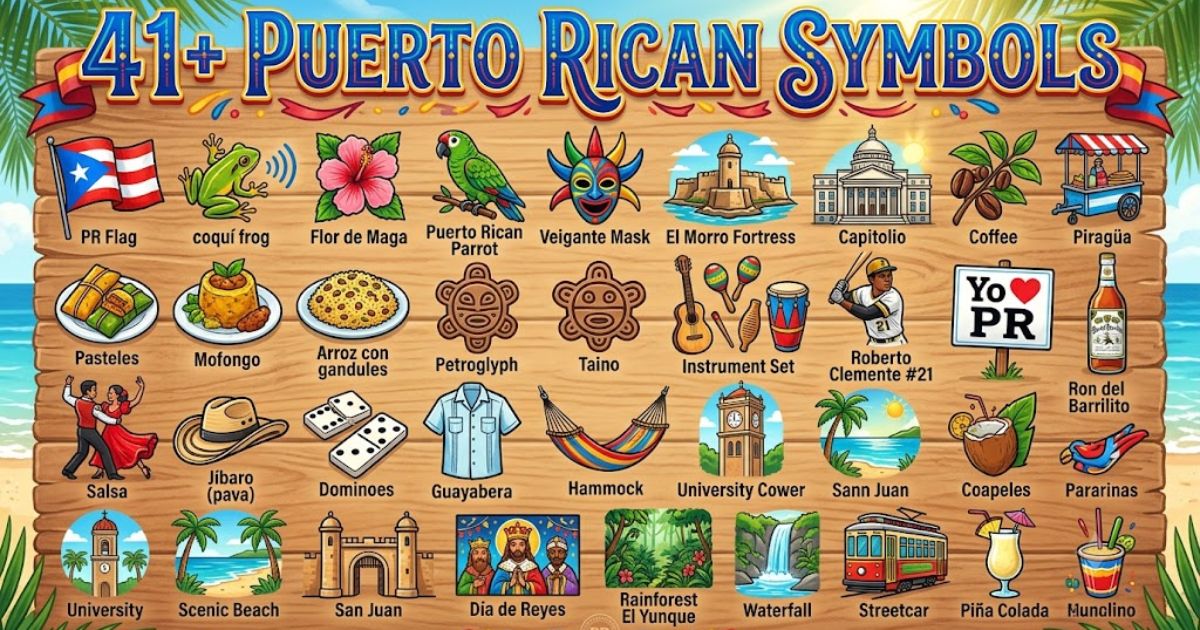

Puerto Rico is an island that speaks in symbols. From the echoing nighttime call of a tiny frog to the sacred spirals carved into ancient rock faces, every symbol on this island carries centuries of story. Whether you are Boricua by blood, connected to the culture through community, or simply curious about one of the Caribbean’s most vibrant civilizations, understanding Puerto Rican symbols unlocks a deeper relationship with the island’s true soul.
This guide covers 41+ Puerto Rican symbols and their meanings, from official national emblems to Taíno petroglyphs, tattoo traditions, and spiritual protections. By the end, you will see why these symbols still matter deeply in communities across Puerto Rico and throughout the diaspora.
What Are Puerto Rican Symbols?
Puerto Rican symbols are visual representations of the island’s identity, history, spirituality, and natural world. They come from three primary cultural roots: the Taíno indigenous people, the Spanish colonial era, and the African heritage brought through the transatlantic slave trade. Together these three streams created a culture unlike any other in the Caribbean, and its symbols reflect that beautiful complexity.
Some symbols are officially designated by the government of Puerto Rico, such as the flag, the coat of arms, and the national flower. Others, like the coquí frog and the Taíno sun, hold unofficial but deeply felt cultural authority. Still others survive in the form of ancient petroglyphs, carved into cave walls and riverside boulders across the island, waiting to be read by anyone who takes the time to look.
Puerto Rican Symbols And Their Cultural Meanings
Puerto Rican symbols are not decorations. Each one is a compressed story, a shortcut to a conversation about identity, survival, resilience, and pride.
Puerto Rican Symbols And Meanings
Below is a quick-reference overview of the most recognized Puerto Rican symbols and what they stand for:
| Symbol | Category | Core Meaning |
| Coquí Frog | Nature / Taíno | Home, pride, resilience |
| Taíno Sun (Sol Taíno) | Taíno | Life, energy, spiritual power |
| Puerto Rican Flag | National | Freedom, sacrifice, unity |
| Flor de Maga (Hibiscus) | National Flower | Natural beauty, island identity |
| Royal Palm Tree | National Tree | Dignity, strength |
| Atabey (Mother Goddess) | Taíno | Fertility, fresh water |
| Cemi (Zemi) | Taíno | Ancestral spirit, protection |
| The Spiral | Taíno | Cosmic energy, eternal flow |
| The Turtle | Taíno | Origin of life, fertility |
| Puerto Rican Parrot (Iguaca) | Nature | Rarity, ecological pride |
| El Pitirre (Grey Kingbird) | Nature | Fearlessness, standing your ground |
| Coat of Arms | National | Colonial and religious heritage |
| Ceiba Tree | Nature / Taíno | Ancestral connection, strength |
Puerto Rican Symbols Tattoos
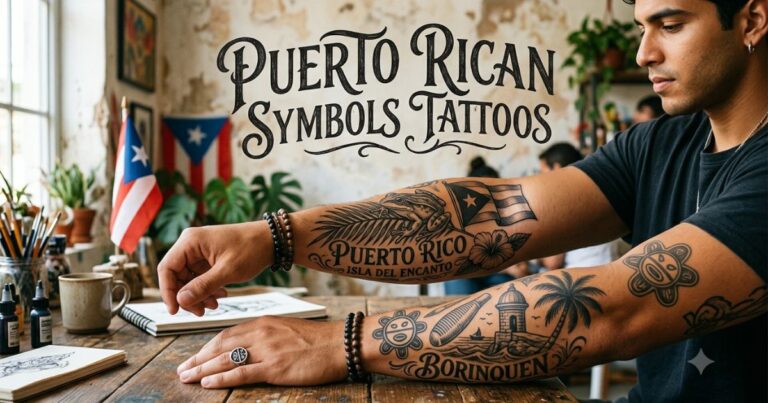
Tattoos are one of the most personal and permanent ways Puerto Ricans and members of the diaspora express cultural identity. The most popular Puerto Rican symbol tattoos include:
- The coquí frog, representing home no matter where you live
- The Sol Taíno (Taíno sun), symbolizing indigenous ancestry and strength
- The Puerto Rican flag, worn as a badge of national pride
- Atabey, the mother goddess with frog-like legs, representing fertility and feminine power
- The Taíno spiral, representing eternal cosmic energy
- The Flor de Maga, honoring the island’s natural beauty
- The ceiba tree, connecting the wearer to ancestral roots
Many Puerto Ricans raised in New York, Chicago, Orlando, or other mainland US cities choose these tattoos as a way of saying, “No matter how far I go, I carry home with me.”
Taino Symbols And Meanings
The Taíno people were the original inhabitants of Puerto Rico and much of the Caribbean. Their written language took the form of petroglyphs, symbols carved or painted onto cave walls, riverside rocks, and stone monoliths. These symbols are estimated to date from roughly 2000 BCE to 1500 CE, representing thousands of years of indigenous expression.
Key Taíno symbols and their meanings include:
- Atabey:
Mother goddess of fertility and freshwater, depicted with a woman’s head and body but the legs of a frog
- Yocahu:
Supreme being and god of the sea and cassava
- Cemi (Zemi):
Spiritual force or deity, represented in three-pointed stone sculptures and used in ceremonies
- The Sun (Guey):
Cosmic cycle, life and death, spiritual power
- The Turtle:
Origin of life, maternal energy, connection to Mother Earth
- The Spiral:
Cosmic energy, fresh water, infinity
- The Great Seal:
Authority and tribal bloodline, depicted with two branches surrounded by 24 leaves of the sacred Cojobana tree
- Eternal Lovers:
Depicted as birds joined at the beak, representing love, equality, and fertility
- The God of Force:
Holding a tree trunk, symbolizing willpower and abundance
Puerto Rican Symbols Copy And Paste
For those looking to share Puerto Rican cultural pride online, some commonly used digital symbols include:
🇵🇷 Puerto Rican Flag Emoji 🐸 Coquí (closest emoji) 🌺 Hibiscus Flower 🌞 Sun Symbol 🌀 Spiral
These are frequently used in social media posts, bios, and messages to express Boricua identity and heritage.
Puerto Rico Taino Symbols
Taíno symbols in Puerto Rico are most visibly preserved at archaeological sites across the island. Some key locations where original petroglyphs can be found include:
- Cagüana Ceremonial Center, Utuado:
One of the most significant Taíno ceremonial plazas in the Caribbean, featuring multiple petroglyphs representing Taíno deities
- La Piedra Escrita, Jayuya:
Symbols carved into rocks beside the Jayuya River
- El Yunque Rainforest:
Hidden petroglyphs throughout the forest, many still unmarked to the public
- Rio Blanco, Naguabo:
Seven different petroglyph sites accessible by trail
Puerto Rico Taino Symbols Tattoos
Taíno tattoo art has experienced a major revival over the past two decades. Artists and wearers approach these designs as acts of cultural reclamation, honoring ancestors whose civilization was nearly erased by colonization. Popular designs include the Atabey figure, the Cemi, the Sol Taíno, the spiral, and the frog, all drawn from the original petroglyph tradition.
Famous Symbols That Represent Puerto Rico
Taino Sun Symbol Meaning
The Sol Taíno, or Taíno Sun, is arguably the most recognized indigenous symbol associated with Puerto Rico. It is depicted as a circle with a geometric face at its center and rays emanating outward in a balanced, symmetrical pattern. For the Taíno people, the sun and moon were both said to have been born in the same cave, the cave of Mautiatibuel, the “Lord of the Dawn.” The sun represented the cycle of life and death, cosmic order, and spiritual power.
Today the Sol Taíno is the most commonly tattooed Puerto Rican symbol in the diaspora community. Its ancient origin, predating Spanish arrival by more than a thousand years, gives it an authority and depth that resonates with people seeking to honor indigenous heritage.
Puerto Rico Symbol Frog
The coquí is a small tree frog native only to Puerto Rico. It is named for its distinctive nocturnal call, which sounds unmistakably like “ko-kee.” The male coquí’s song has been measured at 90 to 100 decibels, making it one of the loudest amphibians on earth. This tiny frog has been on the island for approximately 29 million years and was deeply integrated into Taíno spirituality long before European contact.
The Taíno linked the coquí to the coming of rain and the wet season, and the frog’s likeness appears frequently in their petroglyphs. The most famous Taíno legend connected to the frog tells of Atabey, the goddess who loved a man named Coquí. When the storm god Juracan swept him away, Atabey created the little frogs so they would call his name every evening for eternity.
Puerto Rican Symbols Toa
The Toa symbol in Taíno culture is closely connected to the concept of motherhood. In Taíno language, “toa” means mother. According to legend, when the god Guahoyona abducted all of the women from the island, the children were left crying “toa, toa” in hunger and grief. The men who could not console their children were transformed into frogs. This legend connects the Toa symbol directly to the coquí and to themes of loss, longing, and the sacred bond between mother and child.
Taino Puerto Rican Symbols
The broader category of Taíno Puerto Rican symbols includes not just the coquí and the sun but also the following:
- Conch Shell:
Used as a communication tool during hunts and as a ceremonial instrument
- Snail:
A source of food and hallucinogenic substance used in rituals
- Birds (Herons and Cranes):
Given human characteristics, representing masculinity and tribal members
- Human Figures:
Representing shamans, hunters, ball game players, and the spiritual world
- Moon Symbol:
Connected to night, seasons, and the divine feminine
Puerto Rican Tattoos
Beyond Taíno designs, Puerto Rican tattoo culture is rich and varied. Common tattoo themes include the Puerto Rican flag with the five-pointed star, the coquí paired with tropical foliage, Old San Juan architecture especially the iconic El Morro fortress, la ceiba tree with roots representing family ancestry, and bomba and plena musical imagery reflecting Afro-Puerto Rican heritage.
Puerto Rican Taino Symbols
The cultural boundary between “Puerto Rican” and “Taíno” is intentionally blurred when it comes to symbols, because Taíno heritage runs through the DNA and daily life of most Puerto Ricans. Studies have found that over 60 percent of Puerto Ricans carry mitochondrial DNA from Native American ancestry, making Taíno symbols genuinely ancestral for the majority of the island’s population.
Puerto Rico Symbols
Official and unofficial Puerto Rico symbols together form a comprehensive picture of the island’s identity:
Official National Symbols:
- Flag: Red, white, and blue tricolor with a white five-pointed star in a blue triangle
- Coat of Arms: Featuring a lamb, a book, castles, and towers
- National Anthem: La Borinqueña, using the Taíno name for the island
- National Flower: Flor de Maga (Thespesia grandiflora)
- National Tree: Royal Palm (Palma Real)
- National Bird: Puerto Rican Tody (officially approved 2022)
Unofficial But Beloved Symbols:
- Coquí Frog
- Taíno Sun
- Ceiba Tree
- Puerto Rican Parrot (Iguaca)
- El Pitirre (Grey Kingbird)
Symbols Of Puerto Rico
Puerto Rico is nicknamed “La Isla del Encanto,” the Island of Enchantment, and its symbols reflect exactly that: a rich, layered enchantment woven from indigenous wisdom, Spanish history, and African soul.
Puerto Rican Protection Symbols
Many Taíno symbols served protective spiritual functions. The Cemi, for example, was believed to house ancestral spirits that could shield the living from harm. Families and caciques kept cemi idols in their homes and offered food during ceremonies. Even today, many Puerto Rican families maintain home altars blending Taíno, African, and Catholic traditions where protective symbols from all three heritages coexist.
Traditional Puerto Rico Symbols And National Identity
Things That Represent Puerto Rico
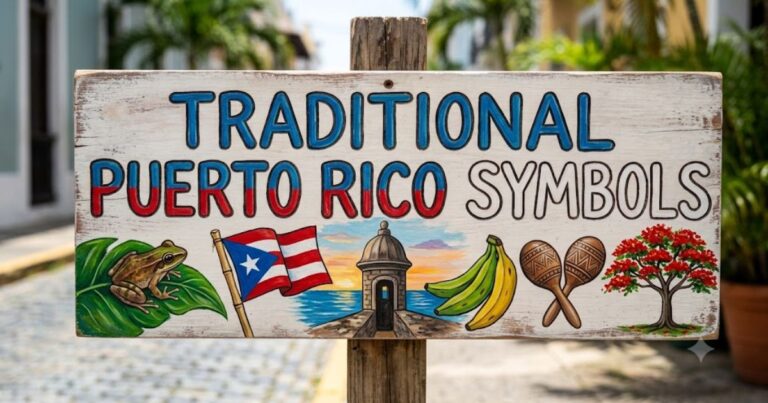
Puerto Rico is represented not just by its official symbols but by everything that makes its culture instantly recognizable:
- The coquí’s nighttime song
- The smell of sofrito and lechón
- Bomba and plena music
- The blue cobblestones of Old San Juan
- The ceiba tree’s vast canopy
- The crimson flash of the Flor de Maga
- El Morro fortress rising above the Atlantic
Puerto Rico Symbols And Meanings
Every Puerto Rican symbol is rooted in a deeper meaning:
| Symbol | Meaning |
| Puerto Rican Flag | Freedom, sacrifice, and democratic ideals |
| Coquí | Home, belonging, and the voice of a small island heard worldwide |
| Flor de Maga | Natural beauty, endemic pride, ecological uniqueness |
| Royal Palm | Dignity, resilience, standing tall under pressure |
| Taíno Sun | Ancestral power, life cycles, spiritual authority |
| Coat of Arms | History as a Spanish colony, Catholic heritage, bloodline |
| El Pitirre | The courage to stand up to larger threats |
Puerto Rico National Symbols
The Puerto Rican flag deserves special attention as a national symbol. It was designed by Puerto Rican exiles in New York City in 1895, during the independence movement, drawing direct inspiration from the Cuban flag. Its colors carry specific meaning: the red stripes represent the blood of patriots; the white stripes represent peace, victory, and purity; and the white five-pointed star within the blue triangle represents the island of Puerto Rico and its aspiration toward independence and freedom.
What many people do not know is that under Law 53 of 1948, also called the “Gag Law,” displaying the Puerto Rican flag was illegal and punishable by imprisonment. The act of reclaiming and celebrating the flag later became one of the most powerful expressions of Puerto Rican identity and resistance in history.
Puerto Rico Symbol
If there is one symbol that captures the entire Puerto Rican spirit in a single image, most Boricuas would choose the coquí. Small but impossibly loud, endemic to the island alone, ancient in its connection to the land, it says everything: “We are from here. We are heard. We endure.”
Deep Symbolic Meaning
Every Puerto Rican symbol operates on multiple levels simultaneously. At the surface level, the coquí is a frog. At the cultural level, it is a declaration of homeland. At the spiritual level, it is a connection to Taíno cosmology and the goddess Atabey. At the political level, it is a statement about endurance in the face of colonization, displacement, and natural disaster.
This layering of meaning is what makes Puerto Rican symbols so powerful and so enduring. They are not frozen artifacts. They continue to grow in meaning with each generation that carries them forward, from the Taíno people who first carved them into stone, to the Boricua artist in the Bronx who paints them on a mural, to the diaspora child who gets a coquí tattooed on their wrist before moving across the country.
Types and Variations of Puerto Rican Symbols
The Coquí Frog
The coquí appears in two primary symbolic forms: as the living animal, a small brown or green tree frog with round eyes and sticky toes, and as the Taíno petroglyph, a stylized carving appearing across the island’s sacred sites. In modern usage the coquí appears in jewelry, children’s literature, restaurant names, tourism logos, and countless tattoos. Its shape is instantly recognizable, making it one of the most versatile icons in Puerto Rican culture.
The Sun Symbol (Taíno Sun)
The Sol Taíno appears as a circle with a carved face at the center and geometric rays extending outward symmetrically. It is found carved into stone at ceremonial sites and reproduced in jewelry, fabric, and body art. Variations range from highly detailed petroglyph-accurate reproductions to more stylized modern interpretations.
The Puerto Rican Flag
The flag appears in countless variations in popular culture: with the coquí perched on the star, surrounded by tropical foliage, painted in black and white as a statement of political solidarity, or combined with Taíno imagery to create uniquely personal expressions of identity. The flag is described by many Puerto Ricans as a living symbol that becomes more meaningful with every generation that waves it.
The Coquí Taíno Symbol
The specific Taíno representation of the coquí, as found in petroglyphs, differs from the realistic depiction of the frog. In its Taíno form, it is often more abstract and stylized, connecting it clearly to the spiritual world rather than just the natural one. This Taíno coquí design remains one of the most popular choices for tattoos and artwork among those who want to honor the indigenous roots of their Puerto Rican identity.
The Hibiscus Flower
Puerto Rico’s national flower is technically the Flor de Maga (Thespesia grandiflora), a hibiscus relative that is endemic to the island. It displays large crimson or scarlet blooms and grows nowhere else on earth naturally. In symbolism it represents the island’s unique natural beauty and the fact that Puerto Rico, like the Maga, is one of a kind.
The Taíno Spiral
The spiral is one of the most frequently recurring motifs in Taíno art. It represents cosmic energy, the eternal unending nature of the universe, and fresh water. In Taíno cosmology it connected the material and immaterial worlds. Today the spiral is frequently used in Taíno-inspired tattoo art and jewelry as a symbol of personal transformation and infinite growth.
Puerto Rican Symbols Across Cultures
Puerto Rican symbols have crossed borders in every direction. In the United States, where a significant Puerto Rican diaspora community lives particularly in New York, New Jersey, Connecticut, Florida, and Illinois, symbols like the coquí, the flag, and the Taíno sun appear on murals, in public art installations, in barbershops and bodegas, and on streetwear.
The 1960s and 1970s Young Lords movement in New York used the Puerto Rican flag extensively as a symbol of community pride and resistance to racial discrimination. Hip-hop culture, rooted in part in Bronx neighborhoods with large Puerto Rican populations, wove Boricua imagery into lyrics, visual art, and fashion. From Juan Flores’s documentation in “From Bomba to Hip-Hop” to contemporary Latin trap and reggaeton, Puerto Rican symbols continue to travel and evolve in global culture.
Puerto Rican Symbols in Art, Movies and Pop Culture
Puerto Rican symbols show up throughout film, television, music, and visual art. West Side Story, despite its complicated representation of Puerto Rican characters, introduced the Puerto Rican flag to mainstream American audiences. Lin-Manuel Miranda’s musical In the Heights is saturated with the visual and cultural vocabulary of Washington Heights Puerto Rican identity, including flags, neighborhood murals, and the emotional power of home. The animated series and the work of Afro-Latino artists across social media continue to amplify Taíno and Boricua symbols to new global audiences.
The coquí specifically has crossed into children’s books, animation, and merchandise worldwide. Its simple, charming shape makes it universally accessible while carrying enormous cultural depth for those who know its story.
Spiritual and Dream Meaning of Puerto Rican Symbols
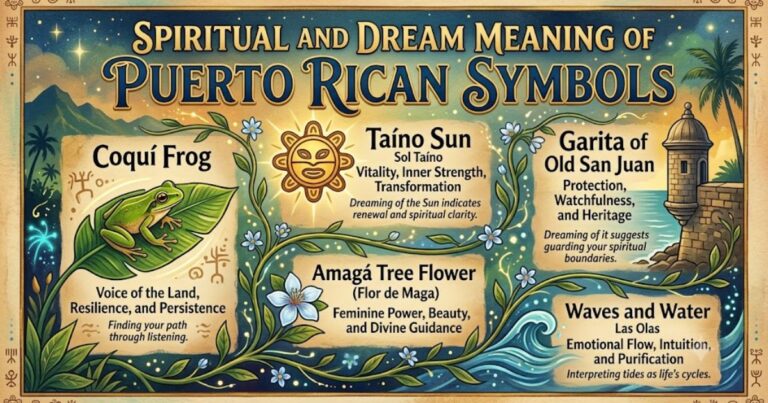
In Puerto Rican folk spiritualism, known as Espiritismo, symbols hold active spiritual power. This tradition blends Taíno, African, and Catholic spiritual beliefs into a unique cosmology where ancestral spirits communicate with the living. Cemi idols, protective symbols, and natural elements all participate in ceremonies, altar arrangements, and healing rituals called limpiezas.
In dream interpretation within this tradition, hearing the coquí in a dream often signals a longing for home or a need to reconnect with roots and family. Seeing the Taíno sun in a dream suggests spiritual awakening or a new beginning taking shape. The spiral, when it appears in dreams, typically points toward personal transformation and growth in progress. Many Puerto Rican families maintain home altars where sacred symbols from Taíno, African, and Catholic traditions coexist peacefully, honoring the three roots of the culture simultaneously.
Positive vs Negative Meaning
Like all powerful symbols, Puerto Rican icons carry complexity. On the positive side, they represent pride, resilience, belonging, beauty, and the survival of a culture that faced extraordinary violence and erasure. They help Puerto Ricans feel seen and connected whether they live in San Juan or the South Bronx.
The contested dimensions are equally real. The Puerto Rican flag means different things to independence advocates, statehood supporters, and those who favor the current commonwealth status. It has been used to unite and to divide. Taíno symbols, meanwhile, face a complex question of authenticity, since the Taíno people were officially declared extinct by the Spanish in 1565, yet their DNA, language, and cultural practices clearly survived. Who has the right to claim these symbols, how they should be used, and what it means to honor versus appropriate them are ongoing and important conversations within the Puerto Rican community.
Why Humans Are Attracted to Puerto Rican Symbols
Humans are fundamentally symbolic creatures, and Puerto Rican symbols speak to universal needs. They offer belonging in a world that can feel fragmented. They compress centuries of history into a single image, making the past accessible and personal. They connect individuals to something larger than themselves: a people, a landscape, a spiritual tradition, a struggle for dignity.
For the Puerto Rican diaspora especially, symbols perform crucial identity work across generations. A grandchild born in New York who has never heard the coquí in person may still feel its call through art, tattoos, and stories passed down at the family table. The symbol keeps the connection alive across time and distance. That is what great symbols do. They outlast every colonial attempt to silence them.
FAQs
What is the most important Puerto Rican symbol?
The coquí frog is widely considered the most important Puerto Rican symbol, representing home, pride, and the island’s unique identity as felt by Boricuas worldwide.
What does the coquí symbolize in Puerto Rico?
The coquí symbolizes belonging, resilience, and the voice of a small island that refuses to go unheard, rooted in both Taíno spirituality and modern Puerto Rican cultural pride.
Are Puerto Rican symbols spiritual?
Yes, many Puerto Rican symbols, especially Taíno petroglyphs like the Cemi and Atabey, carry deep spiritual meaning connected to ancestral protection, cosmic energy, and the Taíno belief system.
Why are Taíno symbols important?
Taíno symbols preserve the history and worldview of Puerto Rico’s original indigenous people and affirm that their legacy continues to live through the culture, DNA, and identity of modern Puerto Ricans.
Can anyone use Puerto Rican symbols in tattoos?
Anyone can use these symbols in tattoos, but approaching them with knowledge and genuine respect for their cultural and spiritual weight makes the art more meaningful and avoids superficial appropriation.
Conclusion
Puerto Rican symbols are not relics. They are living expressions of a culture that has survived colonization, displacement, natural disaster, and economic hardship while continuing to create, celebrate, and endure. From the ancient Taíno petroglyphs carved into river rocks to the coquí emoji sent across a diaspora text thread, these symbols carry the same essential message across thousands of years: we are from here, we belong to this land, and we will be heard.
https://englishfleat.com/chat-dating-app-notification-symbols/
Whether you are exploring Puerto Rican identity for the first time or deepening a lifelong connection, understanding these symbols is one of the most meaningful ways to honor the island’s true soul.