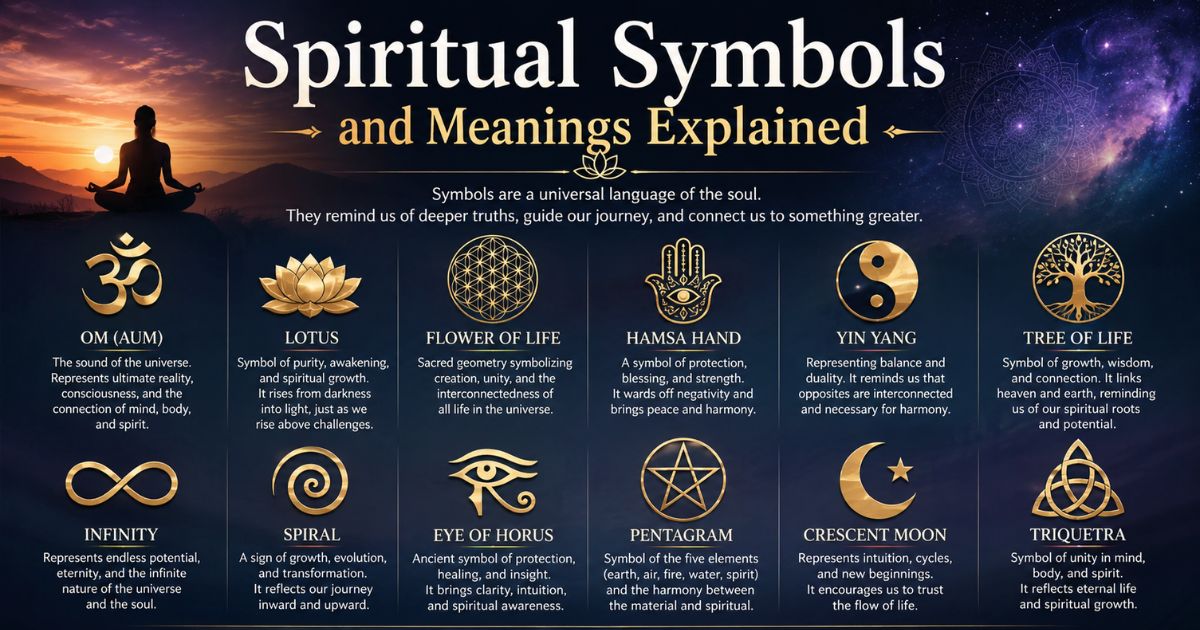

Every civilization that has ever existed left behind symbols. Carved into stone, painted onto skin, stitched into fabric, or built into temples, these marks carried something that spoken words could not always deliver.
They connected the physical world to the unseen, the individual to the divine, and one generation to the next. Today, spiritual symbols and meanings continue to guide millions of people in their personal journeys of faith, healing, self-discovery, and transformation.
Whether you are exploring ancient spiritual symbols for the first time or searching for a deeper understanding of signs you have seen your whole life, this complete guide covers everything you need to know. From the Ankh to the lotus flower, from Hindu yantras to Native American totems, every major symbol is explained here with clarity and depth.
What Are Spiritual Symbols and Meanings?
Spiritual symbols are sacred images, shapes, or signs that represent deeper truths about life, the universe, and the human soul. They are not random designs. Each one emerged over thousands of years as people across the world tried to communicate ideas that ordinary language could not fully capture, including life, death, divine power, protection, transformation, and balance.
A spiritual symbol is essentially a visual language. When words reach their limit, a symbol steps in. The lotus speaks of rising above suffering. The infinity sign speaks of continuity. The spiral speaks of growth and cycles. Each carries a specific energy, rooted in the culture, tradition, or spiritual system from which it emerged.
Spiritual symbols operate on three distinct levels
Deep Symbolic Meaning
Spiritual Level
At the spiritual level, symbols act as bridges between the human and the divine. They have been used in rituals, prayers, ceremonies, and meditation across every known civilization. Wearing or meditating on a symbol is believed to align the practitioner with the energy that the symbol represents.
Psychological Level
Carl Jung proposed that symbols tap into the collective unconscious, a shared reservoir of archetypes and imagery that all humans carry. Ancient symbols like the circle, the serpent, and the spiral appear independently across unconnected cultures because they speak to something deeply woven into human psychology.
Cultural Level
Culturally, spiritual symbols create shared identity. They unite communities under common belief systems. A crescent moon on a flag signals faith. A dreamcatcher above a child’s bed signals protection. Through festivals, rituals, architecture, and art, symbols carry generational memory forward.
Powerful And Ancient Spiritual Symbols
Powerful Spiritual Symbols And Meanings
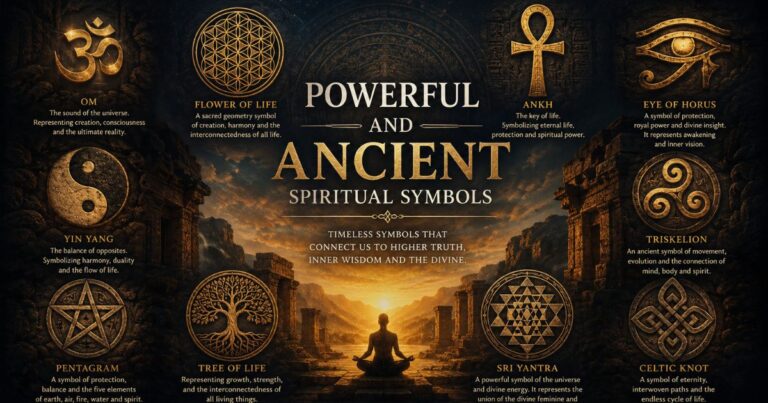
Some spiritual symbols stand out across history because of the breadth of their influence. These are symbols that appear in multiple cultures, survive thousands of years, and continue to carry weight in modern life. The lotus, the ankh, the spiral, and the eye of protection are among the most widely recognized.
7 Spiritual Symbols
The seven most commonly referenced spiritual symbols include:
- The Ankh
Eternal life and divine protection
- The Lotus Flower
Purity, enlightenment, and rebirth
- The Om Symbol
The vibration of the universe and spiritual unity
- The Yin and Yang
Balance of opposing forces
- The Hamsa Hand
Protection from negative energy and the evil eye
- The Spiral
Life cycles, growth, and evolution
- The Eye of Horus
Protection, royal power, and healing
10 Spiritual Symbols And Their Meaning
| Symbol | Origin | Core Meaning |
| Ankh | Ancient Egypt | Eternal life, divine authority |
| Lotus | India, Buddhism | Purity, spiritual awakening |
| Om (Aum) | Hinduism, Buddhism | Universal sound, creation |
| Yin Yang | Chinese philosophy | Balance, harmony of opposites |
| Hamsa | Middle East | Protection, blessing |
| Mandala | Hinduism, Buddhism | Universe, wholeness, meditation |
| Tree of Life | Celtic, Norse, Egyptian | Interconnection, growth, wisdom |
| Spiral | Prehistoric cultures | Life cycles, evolution |
| Cross | Christianity, pre-Christian cultures | Sacrifice, faith, four directions |
| Eye of Horus | Ancient Egypt | Protection, healing, power |
Ancient Spiritual Symbols And Meanings
The oldest known spiritual symbols predate written language. The spiral, for example, has been found in prehistoric cave art and ancient rock carvings across Europe, Asia, and the Americas. Anthropologists believe these were not decorative marks but visual rituals, used to invoke energy and mark life transitions.
Later civilizations in Mesopotamia, ancient Egypt, Greece, Vedic India, and among Native American peoples developed highly sophisticated symbolic systems. The Egyptian scarab represented rebirth. The Celtic spiral symbolized growth through change. The Hindu mandala embodied the architecture of the inner universe.
Powerful Symbols With Deep Meanings
Symbols that carry deep meaning tend to survive because they speak to universal human experiences. Birth, death, suffering, hope, love, protection, and transcendence are themes no culture escapes. The most powerful symbols touch all of these at once, which is why they endure.
Spiritual Symbols For Life, Healing And Success
Spiritual Symbols For Success
Symbols associated with success and abundance appear across traditions. The dragon in Eastern culture represents power, luck, and strength. The elephant, particularly in Hindu tradition, is linked to Ganesha, the remover of obstacles. The infinity symbol is widely used to represent continuous growth, unlimited potential, and the idea that there is no ceiling on what one can achieve.
Unique Symbols And Meanings
Some of the most meaningful symbols are lesser known but carry remarkable depth. The Unalome, a Buddhist symbol depicting the path to enlightenment, starts with spirals representing confusion and gradually straightens, showing the journey toward clarity. The Sri Yantra, a complex geometric pattern from Hindu tradition, is said to represent the cosmic order and is used in meditation to promote balance and healing on all levels.
Healing Spiritual Symbols And Meanings
Healing symbols appear in nearly every spiritual tradition. The most recognized include:
- The Caduceus
Healing and medicine, rooted in Greek tradition
- The Lotus
Emotional and spiritual renewal
- The Om Symbol
Vibrational healing and mental clarity
- The Hamsa Hand
Clearing negative energy
- The Tree of Life
Restoration of balance and connection
- The Mandala
Used in meditation for focus and emotional healing
- Reiki Symbols
Five sacred symbols used in Japanese energy healing to channel specific healing intentions
Spiritual Symbols And Meanings List
Here is an extended reference list of spiritual symbols and their core meanings:
| Symbol | Meaning |
| Feather | Freedom, spiritual communication, honor |
| Dreamcatcher | Protection from negative dreams, filtering good energy |
| Third Eye | Inner wisdom, spiritual awakening, intuition |
| Infinity | Continuous growth, eternal love, limitless possibility |
| Serpent | Transformation, renewal, healing (Kundalini energy) |
| Star of David | Divine protection, connection of heaven and earth |
| Crescent Moon | Faith, cyclical change, feminine energy |
| Pentagram | Five elements, natural order, spiritual balance |
| Chakra Symbols | Seven energy centers, balance, vitality |
| Medicine Wheel | Life cycles, four directions, healing |
Understanding Different Spiritual Symbols And Their Meanings
Hindu Spiritual Symbols And Meanings
Hindu spiritual symbols form one of the richest and most ancient symbolic traditions on Earth. The Om symbol originates from the Vedas, the oldest Hindu scriptures, and represents the sound of the universe, the union of mind, body, and spirit. The Sri Yantra consists of nine interlocking triangles surrounding a central point called the bindu, representing the cosmos and the human body as one.
Other key Hindu symbols include the Swastika, an ancient symbol of good fortune and auspiciousness that long predates any modern misuse, the lotus representing divine beauty and spiritual purity, and the Trishula (trident) associated with Lord Shiva, representing the three aspects of creation, preservation, and destruction.
Native American Spiritual Symbols And Meanings
Native American spiritual symbols represent a relationship with the natural world that runs deeper than decoration. With over 574 federally recognized tribes in the United States alone, meanings vary significantly across nations, but several symbols carry broad recognition.
The Medicine Wheel or sacred hoop represents the interconnectedness of life, seasonal cycles, and the four cardinal directions. The Eagle is considered a messenger between humans and the Creator, representing courage, wisdom, and spiritual vision. The Dreamcatcher, originating from the Ojibwe people, is hung near sleeping areas to filter negative energy and allow positive dreams to pass through.
Other significant Native American symbols include the Bear for strength and healing, the Wolf for loyalty and family unity, the Turtle for longevity and Mother Earth, the Arrow for direction and protection, and the Thunderbird for divine power and protection. Each symbol tells a story of the tribe’s relationship with the forces of nature and the spirit world.
Spiritual Awakening Spiritual Symbols And Meanings
Spiritual awakening symbols represent the journey from unconscious living to expanded awareness. The Third Eye symbol, common in Hindu and Buddhist traditions, represents inner wisdom and the ability to see beyond the physical. The Unalome depicts the winding path toward enlightenment with its spiraling base gradually straightening into a single line. The Lotus remains the most iconic awakening symbol, representing the soul’s ability to rise from confusion and difficulty toward clarity and light.
Spiritual Tattoo Spiritual Symbols And Meanings
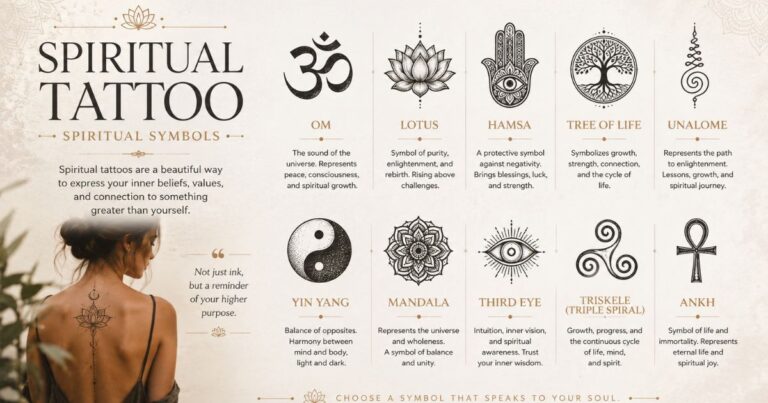
Spiritual tattoos have been practiced across cultures for thousands of years. In Polynesian cultures, tattoos reflected ancestry, status, and personal achievements. Among Native American tribes, body markings honored spiritual beliefs and rites of passage. In Hindu tradition, yantras, deity symbols, and cosmic geometries carry centuries of devotion.
Popular choices for spiritual tattoos today include the Lotus for personal transformation, the Om for universal connection, the Hamsa for protection, the Unalome for the journey of growth, the Tree of Life for rootedness and expansion, and the Ankh for the endurance of the soul.
Deep Insights Into Spiritual Signs And Symbolism
Spiritual Signs And Meanings
Spiritual signs differ from symbols in that they arise in life rather than being deliberately constructed. Repeated numbers such as 111 or 333, an unexpected feather appearing on a path, a specific animal crossing one’s journey, or a feeling of sudden calm in a moment of uncertainty are all considered spiritual signs by many traditions. These are messages from the universe, the divine, or the deeper self, offering guidance to those who are paying attention.
Symbols Meaning Truth
Several symbols across traditions specifically represent truth, clarity, and honest perception. The Eye of Horus in Egyptian tradition is a symbol of clear sight and discernment. The scales in ancient Egyptian and Roman traditions represent truth and justice. The sunlight symbol in many cultures represents illumination, the revealing of what was hidden. The Dharma Wheel in Buddhism represents the truth of the Buddha’s teachings.
Powerful Spiritual Symbolism And Their Importance
Spiritual Symbolism
The reason spiritual symbolism has endured across every known civilization is that symbols compress meaning in a way that language cannot. A single symbol can communicate what would take pages of text to explain. The lotus does not need an essay to say what it means. Anyone who sees a flower blooming in mud immediately understands something about resilience and beauty.
Spirituality Symbols
Symbols of spirituality are used across every major religion and spiritual tradition on Earth. Christianity uses the cross and the fish. Islam uses the crescent and star. Judaism uses the Star of David and the Menorah. Hinduism uses the Om and the lotus. Buddhism uses the Dharma Wheel and the lotus. Indigenous traditions use animals, celestial bodies, and natural elements. In each case, the symbol is a doorway into something larger.
Symbols Of Spirituality And Metaphysical Understanding
Metaphysical Symbols
Metaphysical symbols operate at the intersection of spirituality and philosophy. The infinity symbol represents the eternal nature of reality and the continuous cycle of cause and effect. Sacred geometry, including the Flower of Life and Metatron’s Cube, represents the mathematical patterns underlying all creation. The Ouroboros, the ancient symbol of a serpent eating its own tail, represents the eternal cycle of birth, death, and rebirth.
Spirit Symbol Meaning
Spirit symbols specifically invoke the presence or guidance of the non-physical realm. The feather in many Indigenous traditions represents communication with ancestors or spirit guides. The butterfly across multiple cultures represents the soul in transformation. The owl is associated with wisdom and the unseen world in numerous traditions.
Spiritual Symbols For Tattoos And Cultural Meaning
Spiritual Symbols And Meanings For Tattoos
Choosing a spiritual symbol as a tattoo is a deeply personal decision. The most meaningful choices are those connected to genuine personal experience or sincere cultural understanding. The Lotus is chosen for its message of personal transformation. The Om is selected for its universal vibration. The Hamsa is worn for protection. The Tree of Life speaks to those who value rootedness, family, and growth. The Ankh appeals to those drawn to ancient Egyptian themes of immortality.
African Spiritual Symbols And Meanings
African spiritual symbols are among the most visually powerful in the world. Adinkra symbols from West African Ghanaian culture use geometric forms to represent values and life concepts. The Sankofa bird, depicted looking backward while moving forward, represents learning from the past. The Gye Nyame symbol represents the supremacy of the divine. These symbols appear in fabrics, pottery, architecture, and body art.
Types and Variations of Spiritual Symbols and Meanings
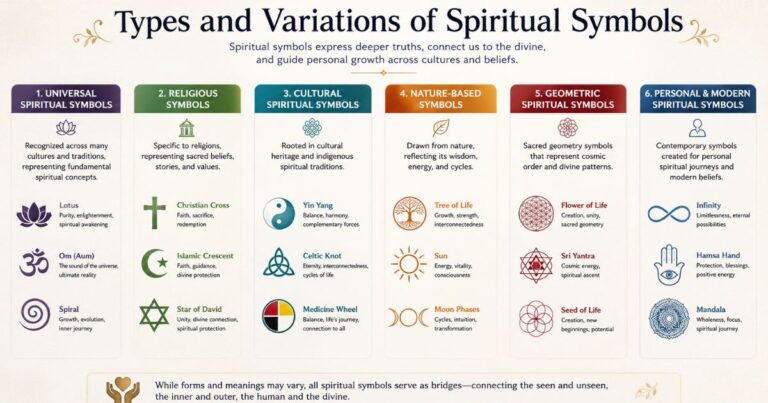
1. The Ankh
The Ankh is one of the most recognizable ancient spiritual symbols, originating in Egypt over 5,000 years ago. Shaped like a cross with an oval loop at the top, it represents eternal life, divine power, and the union of heaven and earth. Egyptian pharaohs and deities were depicted holding the Ankh as a sign of their connection to immortality and divine authority. Today it appears widely in spiritual jewelry, tattoos, and meditation spaces.
2. The Lotus Flower
Growing through muddy water yet blooming in pure beauty, the lotus represents purity, enlightenment, and rebirth. In Buddhism and Hinduism, it symbolizes spiritual awakening and the idea that the most profound transformation often begins in the most difficult conditions. The lotus is one of the most universally beloved spiritual symbols because its message is personal, hopeful, and timeless.
3. The Yin and Yang
Originating in Chinese philosophy before the third century, the Yin Yang represents opposing forces that are not enemies but complements. Yin represents qualities such as rest, darkness, and receptivity. Yang represents activity, light, and expansion. Together they create balance. The symbol teaches that everything in life has a polar opposite and that these forces together create harmony in the natural world.
4. The Cross
The cross is one of the most widely recognized spiritual symbols on Earth. In Christianity it represents the crucifixion of Jesus Christ and carries meanings of faith, sacrifice, forgiveness, and redemption. Beyond Christianity, cross shapes appear in ancient cultures as representations of the four cardinal directions or the meeting point between heaven and earth. As one of the most recognizable spiritual icons, the cross carries a depth of meaning that extends far beyond any single tradition.
5. The Om Symbol
The Om symbol originates from Hinduism and appears in the oldest Hindu scriptures. It represents the vibration of the universe, the sound that was present at the moment of creation. The three components of the Om sound, A, U, and M, represent creation, manifestation, and dissolution. In yoga and meditation, chanting Om is used to center the mind and establish connection with the deeper self and the universe.
6. The Hamsa Hand
The Hamsa is a palm-shaped symbol with an eye at its center, used across multiple religious traditions including Judaism, Islam, and Hinduism. It is traditionally believed to offer protection from the evil eye and negative intentions. The name Hamsa refers to the number five and may represent the five pillars of Islam, the five senses, or the five fingers of a protective hand. It is widely worn as jewelry and displayed in homes to invite blessing and ward off harm.
Spiritual Symbols and Meanings Across Cultures
Ancient Egypt
Egyptian spiritual symbols are among the most studied in the world. The Ankh represented life and immortality. The Eye of Horus represented protection, healing, and royal power. The Scarab represented rebirth and transformation. The Djed Pillar represented stability. These symbols appeared in tombs, temples, jewelry, and royal iconography across thousands of years.
India
India’s spiritual symbolic tradition is vast and ancient. The Om symbol, the Lotus, the Sri Yantra, the Chakra system, the Trishula, and the Swastika in its original sacred form all carry profound meaning within Hinduism and Buddhism. Yantras, which are complex geometric diagrams used as meditation tools, represent different aspects of divine energy.
China
Chinese spiritual symbolism is rooted in the relationship between nature, human beings, and the cosmos. The Yin Yang expresses universal balance. The Dragon represents power, luck, and divine strength. The Phoenix represents renewal and resurrection. The Bagua, used in Feng Shui, maps the flow of energy through space and time.
Ancient Greece
Ancient Greece contributed symbols of wisdom, protection, and the natural order. The Caduceus represented healing and the balance of opposing forces. The Labyrinth represented the journey of the soul. The Pentagram was associated with the Pythagorean school and the five elements. Greek culture integrated these symbols into philosophy, medicine, and everyday life.
Native American Traditions
For Native American peoples, the natural world itself is a living symbol. Every animal, plant, celestial body, and natural force carries spiritual meaning. The Eagle, the Bear, the Wolf, the Turtle, the Medicine Wheel, and the Dreamcatcher are among the most widely known, though meanings vary significantly across the hundreds of distinct tribal traditions.
Spiritual Symbols and Meanings in Art, Movies and Pop Culture
Spiritual symbols have always found their way into visual culture. Ancient temple carvings gave way to illuminated manuscripts, then to Renaissance paintings, and now to films, television, tattoos, and digital art. The Ankh appears in modern fantasy films as a symbol of ancient power. The Om symbol is printed on yoga mats and wellness products worldwide. The Evil Eye is found on jewelry sold in airports from Istanbul to Los Angeles.
In cinema, the Eye of Horus and Egyptian hieroglyphs signal mystery and power. The Tree of Life appears as a motif in films exploring family and continuity. The mandala serves as a visual anchor in stories about meditation, healing, and inner transformation. Pop culture rarely captures the full depth of these symbols, but it does keep them visible and spark genuine curiosity in new generations.
Spiritual and Dream Meaning of Spiritual Symbols and Meanings
Dreams have long been considered a space where spiritual symbols appear most naturally. Carl Jung viewed dream symbols as communications from the unconscious mind, often using the same imagery found in ancient mythologies. Dreaming of a lotus may signal a period of personal transformation. Seeing a spiral in a dream may reflect a sense of change and evolution. An anchor or a cross in a dream often relates to questions of faith and stability.
Many spiritual traditions teach that symbols appearing repeatedly in dreams deserve attention. They may be carrying a message about an unresolved issue, a coming change, or a deeper wisdom trying to rise to the surface.
Positive vs Negative Meaning
Most spiritual symbols carry overwhelmingly positive meanings in their original contexts, but interpretation can shift depending on tradition, time period, and usage. The Swastika is the clearest example of a symbol whose original meaning of good fortune and auspiciousness became overshadowed by its appropriation in the twentieth century. The serpent represents healing and transformation in most ancient traditions but takes on negative associations in certain religious contexts.
Understanding the original cultural context of any symbol is essential before adopting it. This is especially true for symbols from living traditions where meaning is still actively held and practiced by communities.
Why Humans Are Attracted to Spiritual Symbols and Meanings
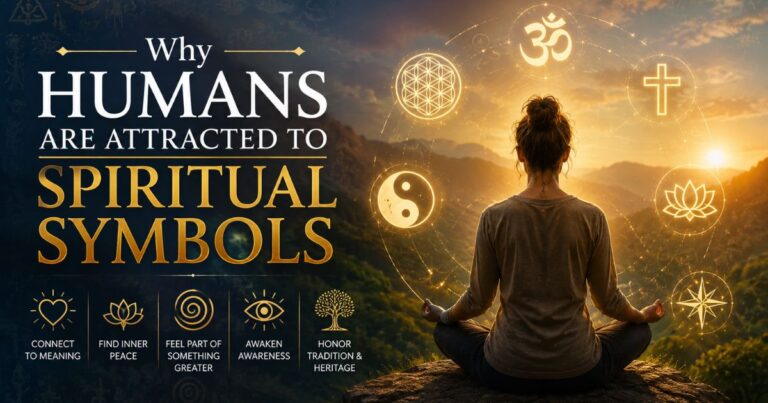
The attraction to spiritual symbols runs deeper than aesthetics. Humans are pattern-seeking creatures, and symbols are patterns loaded with meaning. At a spiritual level, symbols give hope. They remind people that life has layers beyond what the eye can see. At a cultural level, symbols create belonging. Wearing a symbol connects an individual to something larger than themselves, to a lineage, a community, a set of values.
At a psychological level, symbols feel timeless. Looking at a mandala or an ancient carving creates a sense of connection to every person across history who searched for the same answers. This is why spiritual symbols remain relevant in a world saturated with information. They communicate what cannot be typed into a search bar.
FAQ’s
What are the most powerful spiritual symbols?
The most powerful spiritual symbols include the Om, the Ankh, the Lotus, the Cross, and the Yin Yang. Their power comes from centuries of collective belief and their ability to represent universal human experiences.
Are spiritual symbols universal?
Some symbols, like the circle or the spiral, appear independently across cultures, suggesting universal resonance. However, specific interpretations vary significantly by tradition, and cultural context always matters.
Can spiritual symbols influence the subconscious?
Yes. According to Jungian psychology, repeated exposure to meaningful symbols can shape thoughts, emotions, and behavior by activating deep archetypal patterns in the unconscious mind.
Is it okay to wear symbols from another culture?
It is important to approach symbols from other cultures with genuine understanding and respect. Learning the origin and significance of a symbol before wearing it is strongly advised, particularly for symbols that hold sacred or ceremonial meaning for living communities.
Why do spiritual symbols appear in dreams?
Spiritual symbols appear in dreams because the unconscious mind communicates in imagery and metaphor rather than words. Many traditions teach that a symbol appearing in a dream is carrying a message from the deeper self or from a spiritual dimension beyond ordinary awareness.
Conclusion
Spiritual symbols and meanings are not relics of the past. They are living languages that continue to carry wisdom, protection, and meaning across thousands of years. Whether you feel drawn to the Ankh’s promise of eternal life, the lotus’s invitation to rise above hardship, the Om’s invitation to connect with the universe’s deepest vibration, or the Hamsa’s quiet protective presence, the symbol that speaks most clearly to you is rarely an accident.
https://englishfleat.com/puerto-rican-symbols/
These symbols survived because they work. They give shape to what cannot be shaped in words. They bridge the seen and the unseen. And they remind every person who encounters them that the search for deeper meaning is one of the most ancient and most human activities there is.
Pay attention to the symbols that catch your eye. They may be carrying a message meant precisely for you.